

Across BlueSkyCSR’s portfolio – 70+ clients served, 200+ projects assessed, 40+ years of collective experience, ₹200+ crore worth of projects assessed – one pattern consistently separates high-impact programmes from those that plateau: the best performers are not running parallel to government schemes. They are plugged into them.
This is a design observation, not a normative argument. The data makes the case more clearly than any framing around intent.
The Scale Problem That CSR Cannot Solve Alone
India’s development challenges are large-scale by design. The NIPUN Bharat Mission, launched in July 2021, targets foundational literacy and numeracy for every child by Grade 3 across 36 states. Poshan Abhiyaan operates through over 1.4 million Anganwadi Workers, reaching more than 100 million beneficiaries nationwide. As of 2024, the National Skill Development Corporation has trained over 30 million people through 600+ training partners across 37 sectors.
These are not gaps waiting to be filled by CSR. They are systems already in motion, with infrastructure, frontline reach, and policy mandates no corporate programme can replicate at comparable cost.
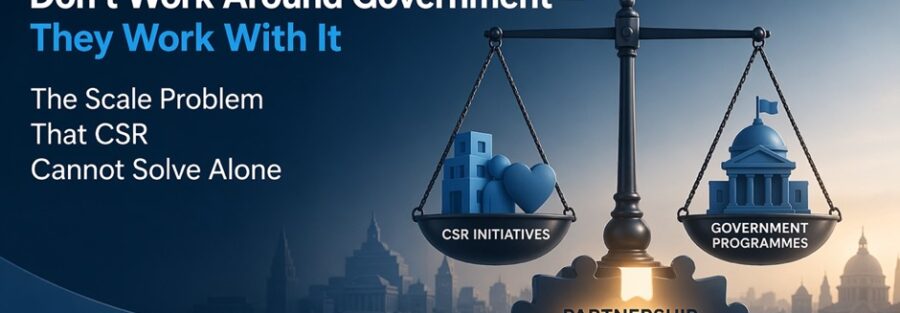
The question for CSR programme designers is therefore not whether government schemes exist. They do. The question is whether CSR investment is structured to compound off that existing infrastructure or to duplicate it.
What BlueSkyCSR’s Assessment Data Shows
In education programmes assessed by BlueSkyCSR aligned with NEP 2020 and NIPUN Bharat priorities, outcomes were measurably stronger than standalone interventions. One assessed programme achieved a girls’ retention rate of 93%. Its design explicitly aligned with NEP 2020’s foundational learning priorities. Rather than building a parallel system, it was accelerating an existing one – using CSR funding to add quality and accountability where government provided reach and institutional continuity.
In nutrition and health programmes, BlueSkyCSR’s recommendations consistently pointed to integration with Poshan Abhiyaan and Ayushman Bharat as the mechanism for sustaining impact post-funding. The logic is structural: Poshan Abhiyaan’s Anganwadi Worker network and its Poshan Tracker application provide real-time monitoring that most NGO-run programmes cannot maintain independently. A CSR programme delivering nutrition interventions without linking beneficiaries to this infrastructure leaves no institutional residue when funding ends.
In skills training programmes, alignment with NSDC frameworks produced a measurable difference in placement credibility. NSDC certification is recognised by employers across government and private sectors – training that leads to an NSDC-recognised qualification enters a labour market with an established reference point. Training without that alignment asks employers to evaluate an unknown credential at the point of hiring.
The Convergence Mechanism
BlueSkyCSR’s cross-project analysis identifies convergence with government schemes as one of the factors most consistently linked to higher PMGA (Programme Maturity and Goals Achievement) scores and stronger long-term impact. Government schemes provide reach and institutional continuity. CSR programmes can contribute quality, accountability, and M&E rigour that government systems often lack at the implementation level. When combined by design, the result is something neither component could achieve independently: scale with accountability.
Convergence also addresses the most common reason CSR programmes fail to sustain impact: the funding cliff. When a programme is structurally integrated with a government scheme, beneficiaries do not disappear from the system when corporate funding ends. They remain within the ICDS network, the Skill India portal, or the NEP implementation structure. The CSR investment effectively transfers its beneficiaries to a system with longer-term maintenance capacity.
Convergence is not co-branding. BlueSkyCSR’s assessment data flags a critical distinction: programmes that list government scheme alignment as a communication point without building it into their logic model, monitoring indicators, and exit strategies do not capture the structural benefit. Convergence must be built into programme design, not appended to reporting.
The Design Question
BlueSkyCSR’s data points to a clear conclusion: identify which government scheme is already addressing the problem you want to solve, understand what that scheme lacks at the implementation level, and design a CSR programme that fills that gap. Not a parallel programme. A complement.
At India’s development scale, the most effective use of CSR capital is almost always additive to government systems, not substitutive of them.