

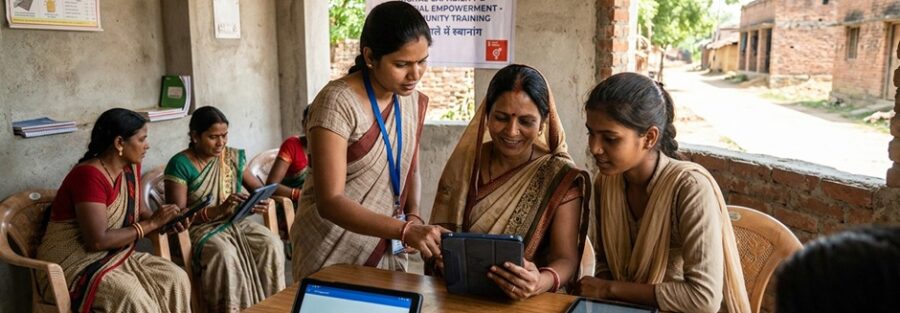
Across multiple CSR impact assessments conducted by BlueSkyCSR spanning rural India, one finding surfaces with enough consistency to warrant closer attention: programs that center women as primary stakeholders, and that invest in their agency rather than just their access, generate returns that extend well beyond the individual.
This is not a judgment about values; it is a conclusion about program design.
BlueSkyCSR’s assessment work covers projects across education, livelihoods, agriculture, and skills training, funded by some of India’s largest CSR contributors. The data, passed through rigorous PMGA (Program Maturity and Goals Achievement) evaluations, BlueSkyCSR’s proprietary accredited methodology, points toward a clear correlation: where women receive structured support with market access and community validation built in, the outcomes are meaningfully stronger.
The Agriculture Evidence
In one regenerative agriculture program assessed by BlueSkyCSR, reaching over 25,000 women farmers across three states, 99% of sampled beneficiaries reported a reduction or complete cessation of household vegetable purchases because the women were now growing their own. More telling is the confidence data: 85% of women reported that their confidence increased “a lot” after training. This matters because confidence is often the precursor to sustained behavior change, and behavior change is what makes programs persist beyond the funding cycle.
Analysis indicates that over five years, the program creates multiple times the value of the initial investment, driven by compounding effects from early gains in soil health and practice adoption.
A second agriculture program assessed by BlueSkyCSR, reaching 650 women farmers across 20 villages in Madhya Pradesh, indicates multiple-fold value creation over the investment. All sampled farmers reported cultivating multiple crops and improved knowledge of organic farming methods. Reduced chemical input dependence has implications for both household savings and long-term soil health and climate resilience.
The Livelihoods Evidence
In a livelihoods program assessed by BlueSkyCSR, 100 women were supported to establish enterprises, 50 self-help groups were formed mobilizing 649 women, and 60 women were trained and licensed in operating agricultural machinery. The program demonstrated multiple-fold value over the long term, with a high level of goal achievement on BlueSkyCSR’s PMGA evaluation.
What distinguishes this program from those that show strong short-term numbers but limited sustainability is its structural design. The self-help groups were formally constituted and linked to financial institutions, which meant that program continuity was not contingent on the implementing partner remaining active. The institutional infrastructure outlasted the program cycle.
This is a design point that CSR practitioners tend to undervalue. A program can achieve strong beneficiary satisfaction scores and still leave no institutional residue. The data from this assessment suggests that formal group structures with financial linkages are a more reliable predictor of post-program continuity than any single-outcome metric.
The Education Evidence
The pattern holds in education as well. In one girls’ education program assessed by BlueSkyCSR, over 99% of participants showed improved understanding across subjects, with a retention rate of 93%.
In a digital literacy program assessed by BlueSkyCSR, targeting students with no prior device access, 87% of participants reported confidence in using digital tools by the program’s end.
What the Pattern Means for Program Design
BlueSkyCSR’s cross-project analysis identifies several factors that recur in programs with strong social returns: experienced implementing partners, community ownership embedded in design, digital monitoring systems, and explicit gender inclusion targets. The gender finding is not isolated; it interacts with these other factors.
Moreover, the data suggests that the mechanism matters as much as the target. Programs that provided women with structured support, which in practice meant group formation, training with follow-through, and access to markets or institutions, consistently outperformed programs that addressed women as recipients of services rather than as actors in an economic system.
However, a gap persists in how most CSR programs are designed. The PMGA evaluation data BlueSkyCSR has compiled points toward structural investment as the differentiating variable, yet most CSR spending still prioritizes reach metrics over structural depth. When the data asks why women-centred programs generate compounding returns, the answer is that the returns are not just gendered. They are structural. Invest in the conditions that allow women to operate, and the outcomes don’t just improve for them; they improve for the households, communities, and supply chains around them.
How to Design Successful Women-Centred CSR Programmes: What BlueSkyCSR’s Work Tells Us
Across BlueSkyCSR’s assessment portfolio, the programmes that generated the strongest outcomes for women shared a set of design features that were present by intention, not accident. They are not difficult principles to articulate. They are, however, consistently absent in programmes that underperform.
Start with a baseline, not an assumption. Every programme that showed meaningful, measurable change in BlueSkyCSR’s assessments had documented the starting conditions. Confidence levels before training. Cropping patterns before intervention. Bank account ownership before the financial literacy module. Without a baseline, a programme cannot demonstrate attribution. It can only describe activity.
Build institutional structures into the design, not the exit strategy. The livelihoods programme data shows this most clearly. Self-help groups formally registered and linked to financial institutions continued functioning after the CSR funding cycle ended. Programmes that treated group formation as a delivery mechanism rather than a structural outcome did not produce the same continuity. The question to ask at the design stage is: what remains when the implementing partner leaves?
Connect training to markets, not just knowledge. Women farmers who received regenerative agriculture training reported high confidence and behaviour change. The programmes that translated this into sustained household economic gains were those that also addressed what women did with their produce: surplus sale, collective pricing, reduced input expenditure. Training without a market pathway changes knowledge. Training with one changes livelihoods.
Use community validation as a programme variable, not a communication output. Across assessed programmes, the confidence data is among the most consistent predictors of sustained behaviour change. When women reported that their families and communities recognised and supported their new roles, the programme outcomes held. When they did not, attrition and reversal were more likely. Community validation is not a soft metric. It is a structural condition for whether individual change persists at the household level.
Align with government scheme infrastructure from the start. Programmes that were explicitly designed around existing government scheme architecture, whether NIPUN Bharat in education, Poshan Abhiyaan in nutrition, or NSDC frameworks in skills training, showed measurably better programme maturity scores than those operating independently. The reason is straightforward: alignment creates continuity pathways for beneficiaries after CSR funding ends. Duplication does not.
Measure what you intend to change, not what is easiest to count. The strongest assessments in BlueSkyCSR’s portfolio tracked outcomes: confidence levels, income changes, crop diversification, digital capability, school retention. The weakest tracked inputs and activities: training sessions conducted, materials distributed, beneficiaries reached. Reach is necessary to report. It is not sufficient to demonstrate that anything changed. A programme designed around outcome indicators from the start produces fundamentally different data than one that retrofits outcome claims onto activity records at reporting time.
The data across BlueSkyCSR’s portfolio does not suggest that designing successful women-centred programmes is complicated. It suggests that most of the failures are predictable, and that the design decisions which prevent them are available at the start, not discovered at the end.
The data is available. The design question is whether CSR programs are being built to capture it.