

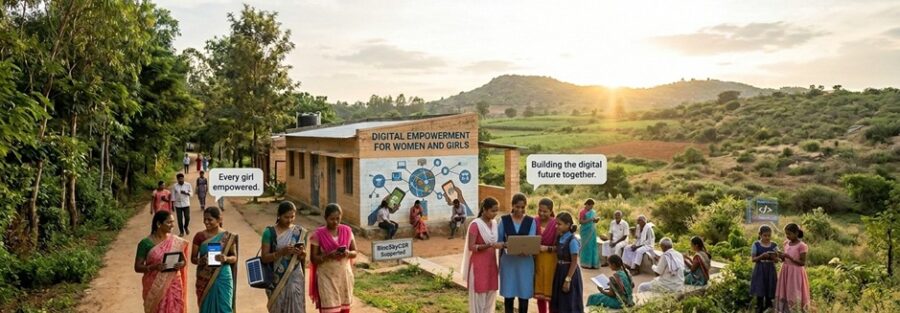
In 2023, the Annual Status of Education Report found young men in rural India more than twice as likely as young women to own smartphones: 44% compared to 20%. Separate survey data placed women’s digital literacy nationally at 29%, against 59% for men. These figures describe a structural gap, not an incidental one – and they point to where a well-designed CSR intervention can generate outsized returns in digital literacy in rural India, particularly when aligned with broader efforts in women literacy and access.
BlueSkyCSR’s assessment data across digital literacy and digital integration programmes shows a consistent pattern: when communities gain genuine functional capability with digital tools – not just device access – the returns extend well beyond the screen.
What the Programme Data Shows
Across a digital literacy programme for girls assessed by BlueSkyCSR, covering 24,213 participants, 83% reported genuine capability using digital devices by programme end. This is not a marginal improvement on moderate familiarity. For most participants, the starting point was no prior access. The shift from zero functional confidence to verified capability is the kind of outcome that persists, because it creates a new relationship with tools increasingly embedded in employment, healthcare, and financial systems. These outcomes reinforce the importance of well-designed digital literacy programs that go beyond basic exposure.
In a STEM and digital career exposure programme assessed by BlueSkyCSR, covering over 1,800 girls, the proportion expressing interest in technology-sector careers shifted from 28% to 64%. That gap is not a measure of coding skills. It is a measure of aspiration – and aspiration is what shapes educational decisions made years before a young woman enters the labour market, particularly in contexts where women literacy and access to opportunities remain uneven.
A financial literacy programme assessed by BlueSkyCSR reached 78,487 individuals, achieving 72% adoption of digital payments and 85% account-opening among participants. This matters because EY and CII’s 2024 financial inclusion analysis found that while India has reached near-parity in account ownership between men and women, 32% of women still hold inactive accounts. Opening an account and adopting digital payments are distinct outcomes, and the gap between them is where financial inclusion programmes most commonly stall. The BlueSkyCSR-assessed programme moved participants across both thresholds.
In an adaptive learning technology programme assessed by BlueSkyCSR, 99%+ of girls reported improved subject understanding across core academic areas – a higher outcome rate than most traditional supplementary education models in comparable contexts. The differentiating design variable was technology that adjusted to individual learning pace rather than class-average pace.
Why Digital Capability Is Not a Standalone Outcome
The ASER 2023 finding on smartphone ownership is worth holding alongside BlueSkyCSR’s programme data. The gender gap in device access is real and well-documented. But it does not fully explain the gap in digital capability, because device access and functional literacy are not the same problem. BlueSkyCSR’s assessments consistently find that programmes focused exclusively on device access without structured training generate far weaker outcomes than those that invest in capability alongside access.
This distinction matters for programme design. A CSR investment that subsidises smartphones without building the skills to use them produces a reach metric, not an impact outcome. The 83% capability figure from the digital literacy programme above was achieved by structured training, not hardware provision.
The financial inclusion data also points to a second-order effect programme designers often underestimate. Women who gain digital payment capability gain durable access to the formal financial system. India’s UPI infrastructure processed 172 billion transactions in 2024, embedded in transactions at every level of the economy. A woman who can navigate UPI is not just paying for goods – she is connected to credit, insurance, and government benefit transfers. The 72% digital payment adoption figure from BlueSkyCSR’s assessment represents 56,510 individuals with a new, lasting connection to that system.
The Design Implication
BlueSkyCSR’s cross-programme analysis identifies digital integration as one of the factors most consistently linked to stronger long-term social returns. Programmes in education, agriculture, and health that incorporate digital tools show measurably higher PMGA scores than structurally equivalent programmes without it.
Digital capability multiplies the reach of every other intervention. A woman farmer who can access market price data or mobile credit captures more value from agricultural training. A girl who builds STEM confidence at 14 makes different educational decisions at 17. A beneficiary who opens a bank account and adopts digital payments during a financial literacy programme remains connected to the formal financial system after the CSR funding cycle ends.
For NGOs making the case to CSR partners for digital literacy investment, the question to lead with is not what digital capability costs. It is what every other programme returns when its beneficiaries have it – especially in the context of scaling digital literacy in rural India through effective, outcome-driven digital literacy programs.