

Consider this: a programme trains 300 tribal women in tailoring. The first two cohorts run well. Completion rates are strong, toolkits distributed, income projections modelled and presented to the board. On paper, the programme is working.
By the third cohort, attendance has fallen sharply.
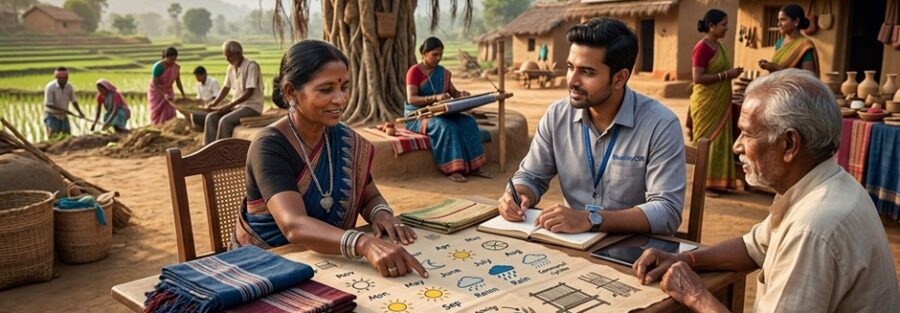
A detailed assessment by BlueSkyCSR traced the problem. The third cohort had been scheduled through harvest season. The women were not disengaged; they were in the fields. Nobody had mapped the community’s agricultural calendar before setting the programme timeline, which meant the sessions fell precisely in the months when attendance was structurally impossible. The garments being taught were urban styles with no viable local market. The workspace design was incompatible with daily household responsibilities. And the programme had never asked whether tailoring was culturally meaningful here; this community had its own living textile tradition that the programme had neither acknowledged nor built upon. Two cohorts of apparent success had masked a design that could not hold up once it ran into the actual rhythms of community life.
The programme was designed in a boardroom. The community was consulted once, at the launch event.
This is not an isolated case. It is a pattern.
The Blindness That Goes Unnoticed
Cultural blindness in CSR is rarely dramatic. It does not usually arrive as overt insensitivity or deliberate disregard. Most often, it is quieter and more systemic – and therefore harder to catch and correct.
It is the assumption that because a livelihood model performed well in one district, it will translate seamlessly to a culturally distinct community three states away. It is the programme calendar structured around the funder’s fiscal year rather than the rhythms of planting, harvest, and festival that govern the community’s actual life. It is the skills training module selected because it matched a trending urban demand, not because it aligned with local knowledge, aspiration, or identity.
It is, at its core, the absence of genuine community co-design.
What the Data Tells Us
BlueSkyCSR’s assessment data consistently shows that CSR programmes co-designed with local communities demonstrate significantly higher adoption rates and stronger sustainability at the three-year follow-up mark. This is not an idealistic finding – it is a practical and financial one.
When programmes are designed without cultural grounding, the costs compound quietly: funds disbursed for training that is not completed, equipment distributed and left unused, impact projections that do not survive contact with reality. The programme continues to report outputs. The community quietly disengages.
By the time an assessment flags the divergence, years of investment have delivered a fraction of the intended value.
What Culturally Grounded Design Actually Requires
Building cultural context into CSR programming is not about adding a community consultation checkbox to the project plan. It requires a fundamentally different design posture – one where community members are partners in problem definition, not recipients of pre-designed solutions.
It means mapping the community’s calendar before setting programme timelines. It means understanding existing livelihood practices, skills, and aspirations before selecting intervention models. It means recognising that traditional knowledge is not a gap to be filled but an asset to be built upon.
It also means asking harder questions during needs assessments: not just “what is this community lacking?” but “what does this community already know, value, and practise – and how can our programme strengthen rather than supplant that?”
The ISO 26000 and SROI Lens
From an ISO 26000 standpoint, community involvement and development is not merely an ethical consideration — it is a governance standard. Genuine participation, respect for cultural rights, and alignment with community priorities are foundational to responsible corporate practice.
From an SROI perspective, cultural misalignment is a value destruction event. Every rupee invested in a programme that the community cannot sustainably adopt is a rupee generating negative social return – and eroding the trust that future programmes will depend on.
A Question Worth Taking Back to Your Team
The tailoring programme described above was not designed by people who did not care. It was designed by people who assumed they already understood enough – and never built in the mechanisms to find out otherwise.
Cultural blindness in CSR is, ultimately, a design flaw. And like all design flaws, it is correctable – but only if it is first acknowledged.
How does your programme embed cultural context from design through to evaluation? What mechanisms exist to surface community voice beyond the launch event?