

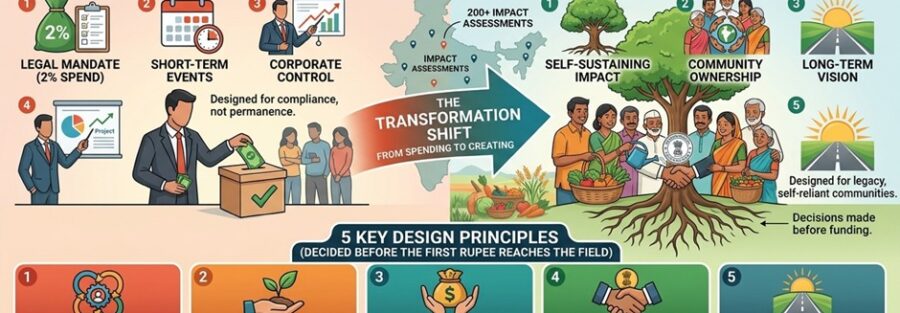
Seven years ago, a CSR manager said something to the BlueSkyCSR team that has stayed with every assessment since: “We just need to spend the 2%. The law requires it.”
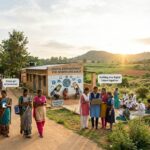
Last month, that same company’s community programme ran its annual harvest event. The corporate team was not present. The NPO partner had moved on two years prior. The community itself had organised the event, funded it through the revolving fund the programme had seeded, and invited local government to participate.
That is not compliance. That is legacy.
It is also entirely replicable. After 200+ impact assessments across India, BlueSkyCSR has found that the programmes which outlast their funding share five design principles. None of them require a larger budget. All of them require intentional choices made early, when the programme is still on paper.
Here is what those choices look like.
START WITH A FIVE-YEAR PICTURE, NOT A ONE-YEAR PLAN
The strongest programmes begin with one honest question: if this works exactly as planned, what will be permanently different in this community in five years? When teams invest time in answering that question before implementation begins, everything that follows — partner selection, activity design, monitoring indicators — aligns around a shared destination. Communities can see where the programme is going. Implementing partners can design for it. Funders can assess progress against something that actually matters.
A clear theory of change does not need to be long or complicated. It needs to be specific enough that, five years later, you can walk back into the community and know whether you arrived.
BUILD INSTITUTIONS, NOT JUST PROGRAMMES
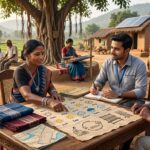
The programmes in BlueSkyCSR’s assessment data that continued to deliver outcomes after funding ended had one thing in common: they had built a community structure capable of carrying the work forward. SHGs, farmer producer organisations, community water committees, waste watch groups. The form varied.
When a community has a formal group with a bank account, a defined mandate, and the confidence to make decisions independently, the programme has given something that persists. The skills developed in the first year become the foundation for the decisions made in Year 5, by people who were not even part of the original cohort.
This kind of institution-building takes time in the early phase of a programme. It pays for itself many times over.
CONNECT THE INTERVENTIONS
People’s lives are integrated. A woman attending a health camp still has a water access problem when she walks home. A farmer learning better agricultural techniques is also a parent thinking about school fees. When CSR programmes reflect this reality — combining water, health, livelihood, digital access, and environment within the same community — they unlock something that single-sector programmes rarely can.
BlueSkyCSR’s assessments consistently show that integrated programmes deliver substantially stronger outcomes than standalone ones. Girls’ education programmes that added digital literacy components saw near-universal improvement in subject understanding. Water conservation projects that included health outreach reached households that neither intervention would have reached alone. The combination is not just more efficient. It is more human.
CONNECT TRAINING TO MARKETS
Skill development works. Market access is what turns it into income. The livelihood programmes with the most durable results in BlueSkyCSR’s data are the ones that answered a question most programmes leave unanswered: and then what?
When farmers complete training, a buyer network is waiting. When women complete an entrepreneurship programme, a platform exists to sell their products. When young people gain digital skills, there is a pathway to employment that was mapped before the training started. This sequencing is what separates a programme that changes a season from one that changes a livelihood trajectory. Building market linkages into programme design from the start is one of the highest-return investments a CSR team can make.
MEASURE TO LEARN, NOT JUST TO REPORT
The programmes that improve most over time are run by teams with a genuine appetite to know what is working and what can be better. They build monitoring systems that surface real information, share that information honestly with funders and partners, and use it to adapt. When something does not work, they say so, adjust, and move on.
This kind of measurement culture produces something valuable beyond the data itself: it produces trust. Communities, partners, and funders all respond to honesty. Programmes that demonstrate it tend to attract the long-term relationships that make the next phase possible.
These five principles appear across BlueSkyCSR’s assessments regardless of sector, geography, or programme size. What they have in common is that they are all design decisions, made before the first rupee is spent in the field.
The CSR manager from the harvest event story did not set out to build a legacy. He set out to spend the 2%. But somewhere in the design of that programme, someone asked the right questions. Someone built a revolving fund. Someone helped a community form a group and trusted it to lead.
The 2% was always the floor. What sits above it is a choice.