


Open Doors, Empty Desks
Girls’ toilets now exist in 98.5% of India’s schools. Yet the official retention rate at the secondary stage is just 51.9%, and the secondary dropout rate stands at 7.0%.
The 19th of November is World Toilet Day, and school sanitation is among the most visible, countable and fundable of CSR activities. But for those assessing impact, the easy count raises a harder question:
If almost every school has the facilities, why do so many children still leave?
- A school with a toilet block is infrastructure.
- A facility that is clean, working and actually used is access.
- A girl who stays through the secondary years is retention.
And this is where CSR and school-infrastructure impact assessment becomes important.
India’s school data shows near-universal provision on paper, and a narrowing path for children as they move up.
- The share of children moving from one stage to the next narrows with each step: 2% from foundational to preparatory, 93.8% to the middle stage, and 88.3% to the secondary stage.
- Only 2% of schools have ramps with handrails, leaving access for children with special needs far behind access to toilets and drinking water.
- Roughly 1,00,843 schools still operate with a single teacher, and 5,663 schools have no enrolled students at all.
These developments point to an important shift: school quality is increasingly being recognised not just by the facilities a school has, but by whether the children it enrols stay, move up and complete.
For companies, that creates an opportunity — but also a measurement challenge.
Does building a school toilet count as health, education or both?
Both are possible. Schedule VII, Item (i) of the Companies Act, 2013 covers sanitation and safe drinking water, while Item (ii) covers promoting education. The annual CSR report format requires each project to be tagged to an item from the Schedule.
That tag matters for assessment. A project reported as sanitation will naturally be judged on hygiene and use; the same project reported as education will be judged on attendance and retention. The honest assessment asks the question the tag does not.
What difference is your school-infrastructure project making?
Most organisations begin their measurement journey by asking: “How many toilets or classrooms did we build?” We believe the better question is: “Is each one working, used and maintained — and are more children, especially girls, staying in school because of it?”
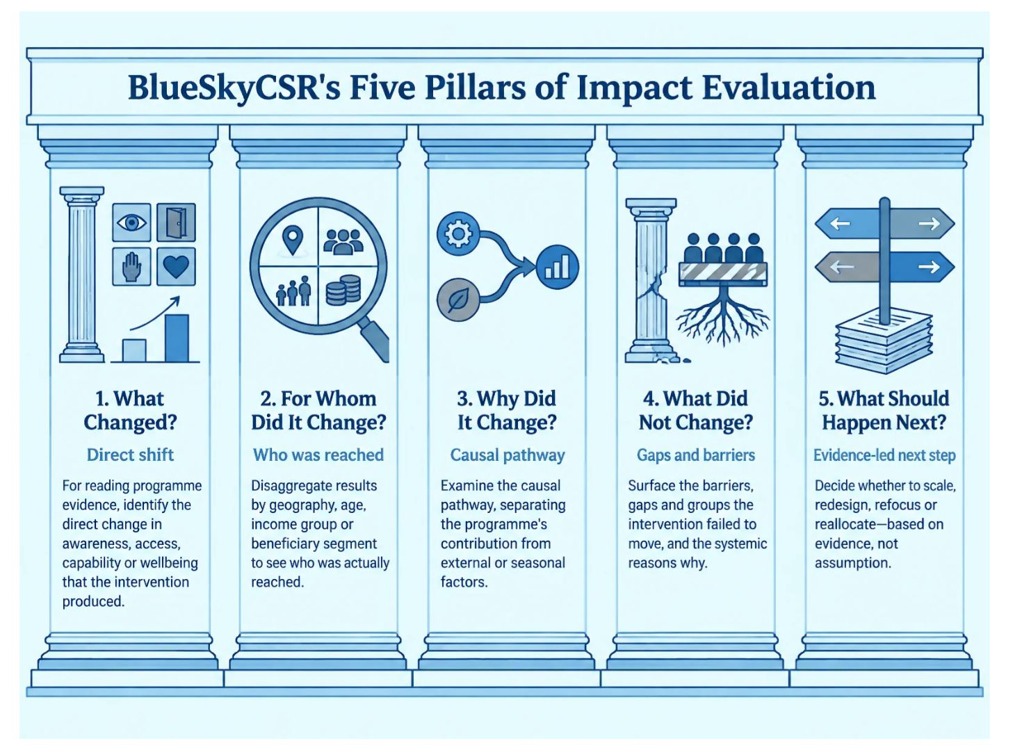
These are useful programme metrics. The further we move along this chain, the more meaningful — and more demanding — the evidence needs to become.
- A completion certificate tells us the structure exists.
- A functionality check tells us it works.
- A usage and maintenance review tells us whether it is used and kept up.
- An attendance and retention trend tells us whether it changed who stays.
Construction becomes function. Function becomes use. Use becomes retention — but only if someone returns after the ribbon is cut.
Five Questions a Good School-Infrastructure Programme Should Answer: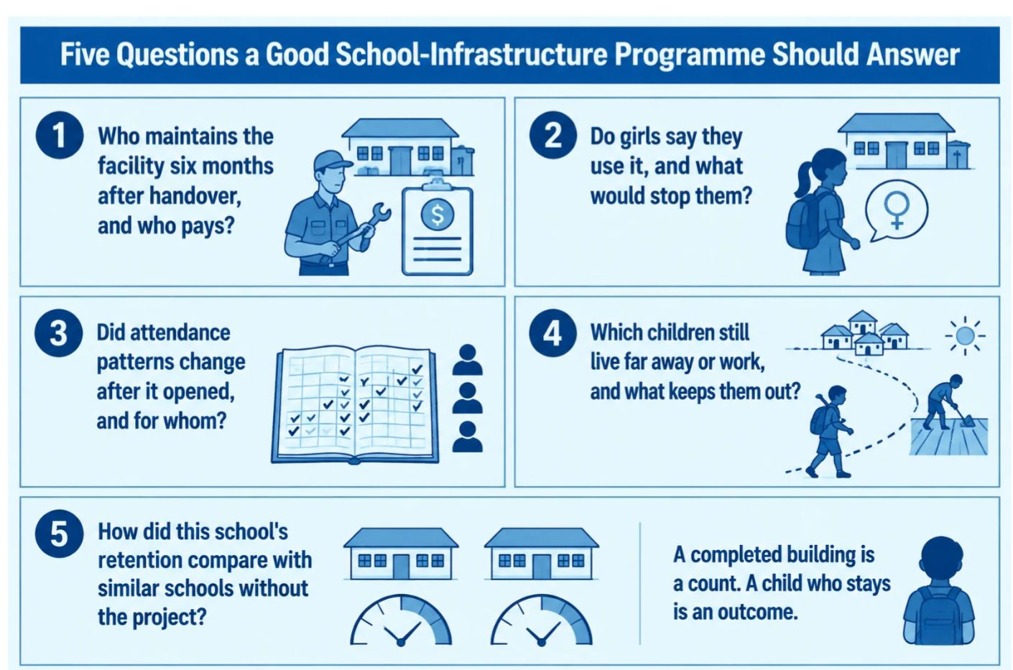
Sometimes the most valuable finding is not what was built. It is discovering that the children who most needed it are not the ones using it.
A strong assessment should therefore be capable of producing uncomfortable findings as well as positive ones.
- If facilities are inaugurated but never revisited after handover, that is important.
- If attendance improves for girls already enrolled but not for those who had already left, that is important.
- If a school’s retention is no better than that of similar schools without the project, that is important.
At BlueSkyCSR, this is the lens we bring to impact assessment. We look beyond completed structures to examine use, upkeep and who stays. Talk to BlueSkyCSR about designing an assessment around the decisions your evidence needs to inform.
Sources
- Press Information Bureau, Government of India (17 August 2026), ‘Beyond the Numbers: Decoding India’s School Education Progress — UDISE+ 2025–26 Report’ — retention, dropout, transition rates, infrastructure and teacher data.
- Ministry of Education, Government of India, UDISE+ 2025–26 (PIB Press Release ID 2282141).
- Ministry of Corporate Affairs, Government of India, Companies Act, 2013 — Schedule VII, Items (i) and (ii); Companies (CSR Policy) Amendment Rules, 2021 — format of the Annual Report on CSR.