

THE BLUESKYVIEW
Evidence. Impact. Better Decisions.
The Number That Went Missing
India’s latest national health survey shows stunting among under-fives falling from 35.5% to 29.3%. Wasting has barely moved, at about 19.0%. And the indicator for child anaemia – 67% in the previous round – was left out of the new fact sheets altogether.
Around Children’s Day, nutrition programmes report meals served, supplements given and children weighed. But for companies funding them through CSR, there is a question that the headline improvement does not answer:
Does a falling national average mean every child is better nourished?
- A child who receives a meal is coverage.
- A child whose height and weight are regularly measured is monitoring.
- A child whose growth and haemoglobin actually improve is a nutrition outcome.
And this is where CSR and child-nutrition impact assessment becomes important.
India’s newest data shows real progress, and also shows how much depends on which indicator is being read.
- Severe wasting fell from 7.7% to 2%, while underweight prevalence moved only from 32.1% to 31.8% – meaning gains were concentrated in one measure, not across all of them.
- Exclusive breastfeeding among infants under six months fell from 63.7% to 55.8% between the two most recent survey rounds, a decline running against the headline trend.
- An analysis by the Observer Research Foundation notes that India remains off track on dietary diversity, anaemia and infant and young child feeding targets, even as stunting declines.
These developments point to an important shift: child nutrition is increasingly being recognised not as a single number moving in one direction, but as a set of indicators that can move apart — and a programme’s claim depends on which one it chooses to report.
For companies, that creates an opportunity – but also a measurement challenge.
Does feeding children count as CSR?
Yes. Schedule VII, Item (i) of the Companies Act, 2013 explicitly lists “eradicating hunger, poverty and malnutrition,” alongside preventive health care, sanitation and safe drinking water. Supplementary nutrition, growth monitoring and community kitchens can all be reported under it.
Government delivery already runs at very large scale – Poshan 2.0 is reported to reach roughly ten crore beneficiaries through about fourteen lakh anganwadi centres – so a company’s contribution usually works alongside, not instead of, the public system. The classification does not say what a company’s money added to that. Only an assessment can.
What difference is your nutrition programme making?
Most organisations begin their measurement journey by asking: “How many meals or supplements did we provide?” We believe the better question is: “What happened to the height, weight and haemoglobin of the children we served?”
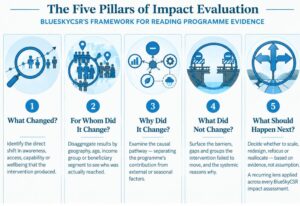
These are useful programme metrics. The further we move along this chain, the more meaningful – and more demanding – the evidence needs to become.
- A meal count tells us how many portions were served.
- A growth-monitoring record tells us whether children were measured at all.
- A repeat measurement tells us whether growth actually moved.
- A comparison with children at nearby centres tells us whether the programme was the reason.
Serving becomes measuring. Measuring becomes growth. Growth becomes evidence – but only if the same child is measured twice.
Five Questions a Good Child-Nutrition Programme Should Answer:
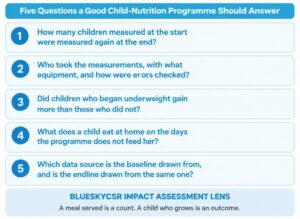
Sometimes the most valuable finding is not how many meals were served. It is discovering that the children measured at the end are not the children measured at the start.
A strong assessment should therefore be capable of producing uncomfortable findings as well as positive ones.
- If meals served are rising while repeat measurements are missing, that is important.
- If the baseline comes from programme records and the endline from a household survey, that is important.
- If children who stopped attending the centre are absent from the final count, that is important.
At BlueSkyCSR, this is the lens we bring to impact assessment. We look beyond meal counts to examine measured growth, who was tracked, and who dropped out of the data. Talk to BlueSkyCSR about designing an assessment around the decisions your evidence needs to inform.
Sources
- Observer Research Foundation (24 June 2026), ‘Reducing Stunting, Building Human Capital: Lessons from NFHS-6’ — NFHS-6 (2023–24) stunting, wasting and underweight figures and progress against targets.
- Ministry of Health and Family Welfare, Government of India (29 May 2026), National Family Health Survey-6 fact sheets, as reported by Medical Dialogues (30 May 2026) — severe wasting and underweight.
- Chatterjee, P. (2026), ‘Dev 360: India’s Child Health — What’s Measured, What’s Missing’, Asian Age — exclusive breastfeeding trend, omission of the anaemia indicator, and NFHS-5 child anaemia figure.
- Anantam IAS (2025), ‘Child Malnutrition: The Stunting India Won’t Shake Off’ — Poshan 2.0 coverage.
- Ministry of Corporate Affairs, Government of India, Companies Act, 2013 — Schedule VII, Item (i).