

THE BLUESKYVIEW
Evidence. Impact. Better Decisions.
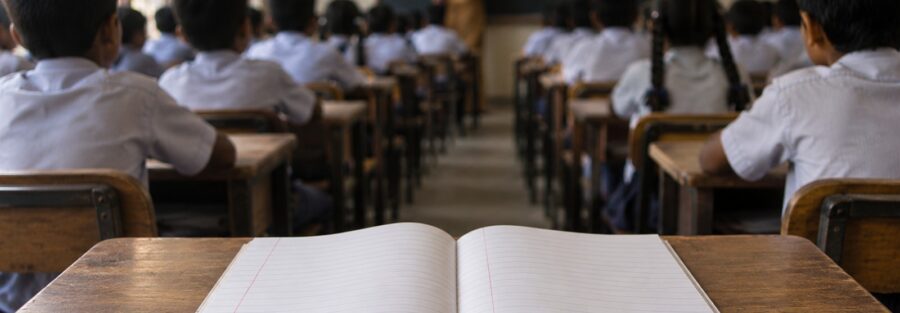
Full Classrooms, Blank Pages
For nearly twenty years, over 95% of rural children aged 6–14 have been enrolled in school. Yet in 2024, only 27.1% of Std III children could read a Std II text, and just 30.7% of Std V children could solve a basic division sum.
Each November, as India marks Children’s Day, corporate education programmes report enrolments, kits distributed and classrooms equipped. But for companies funding them through education CSR, a quieter question deserves attention:
Does a child in school mean a child who is learning?
- A child enrolled and attending is participation.
- A child who can decode words on a page is skill.
- A child who understands what she reads is learning.
And this is where CSR and education impact assessment becomes important.
India’s learning data is changing, and the gap between presence and proficiency is increasingly well documented.
- Among Std V children, 44.8% in government schools could read a Std II text in 2024, against 59.3% in private schools — a recovery from pandemic lows, but from a low base.
- At Std VIII, basic division skills moved from 44.1% to 45.8% between 2018 and 2024 — barely changing, which suggests recent gains are reaching the early grades first.
- More than 80% of schools had received a government directive to run foundational literacy and numeracy activities, yet the survey itself does not claim to show why learning recovered.
These developments point to an important shift: education outcomes are increasingly being recognised not simply as a function of who is enrolled, but as a question of whether children can actually read, calculate and understand at their grade level.
For companies, that creates an opportunity — but also a measurement challenge.
Does a learning programme have to be inside a school to count as CSR?
No. Schedule VII, Item (ii) of the Companies Act, 2013 covers “promoting education, including special education,” especially among children, and is not tied to a place. After-school learning centres, community libraries, teacher-training and remedial-reading programmes are all education CSR activities that can be reported under it.
That breadth is also a limitation. Because so many different activities can sit under a single item, the CSR classification says nothing about whether children’s learning improved. That question can only be answered by measuring learning itself.
What difference is your education CSR programme making?
Most organisations begin their measurement journey by asking: “How many children did we enrol, equip or supply?” We believe the better question is: “Can those children now read and calculate at their grade level — and how do we know?”
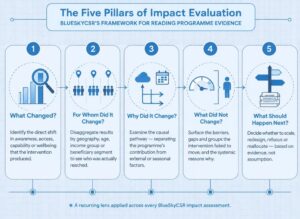
These are useful programme metrics. The further we move along this chain, the more meaningful — and more demanding — the evidence needs to become.
- An attendance register tells us who showed up.
- A baseline-and-endline reading test tells us whether skills moved.
- A comparison with children outside the programme tells us whether the programme caused the change.
- A re-test a year later tells us whether it lasted.
Attendance becomes skill. Skill becomes learning. Learning becomes evidence — but only if each child is actually tested.
Five Questions a Good Learning Programme Should Answer:
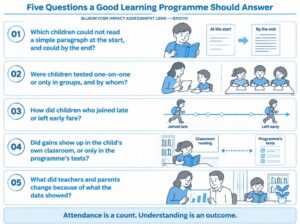
Sometimes the most valuable finding is not how many children attended. It is discovering how many sat through the programme without their reading level changing.
A strong assessment should therefore be capable of producing uncomfortable findings as well as positive ones.
- If attendance at the programme is high but reading levels are unchanged, that is important.
- If gains appear in the programme’s own tests but not in the child’s classroom, that is important.
- If the children who joined latest or left earliest are missing from the final results, that is important.
At BlueSkyCSR, this is the lens we bring to CSR impact assessment. We look beyond enrolment and attendance to examine what children can actually do, and for whom that changed. Talk to BlueSkyCSR about designing an assessment around the decisions your evidence needs to inform.
Sources
- ASER Centre (January 2025), Annual Status of Education Report (Rural) 2024 — as summarised by the Press Information Bureau, Ministry of Education (4 February 2025), and in the Anantam IAS explainer ‘ASER Report’ (2026) for school-type and grade-wise figures.
- PrintWeek India (3 February 2025), ‘ASER 2024: Education goals demand more as tech reshapes books’ — Std III reading trend, 2014–2024.
- Ministry of Corporate Affairs, Government of India, Companies Act, 2013 — Schedule VII, Item (ii).