

THE BLUESKYVIEW
Evidence. Impact. Better Decisions.
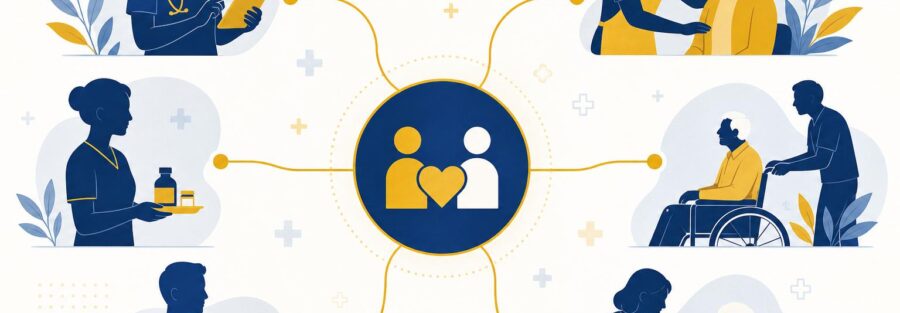
One Woman, Four Different Lens
Companies with an average CSR obligation of ₹10 crore or more must commission an independent impact assessment of CSR projects of ₹1 crore or more completed at least a year earlier. Schedule VII spans at least three separate items — healthcare, livelihood and gender equality — that women’s programmes routinely touch at once, yet are typically evaluated in isolation.
Across the four editions of The BlueSkyView this October — screening, livelihoods, occupational health and survivorship — a single question kept resurfacing in different forms:
Are we measuring women’s health and livelihood as one journey, or as four disconnected programmes?
- A screening camp, an SHG, a wellness check and a survivorship session are each counted as a separate CSR “activity.”
- Tracking whether the same woman’s life actually improved across health and income requires a shared evaluation lens.
- Recognising that livelihood loss can follow a health event — and health decline can follow economic precarity — is what makes an integrated assessment meaningful.
And this is where an integrated CSR impact assessment lens becomes important.
October carries a dual identity worth noticing: it is Breast Cancer Awareness Month, and it is also when many companies commission the independent impact assessments required for the financial year now closing.
- Rule 8(3) of the Companies (CSR Policy) Rules, 2014 requires independent impact assessment of CSR projects with outlays of ₹1 crore or more, completed not less than a year before the assessment — for companies with an average CSR obligation of ₹10 crore or more over the preceding three financial years.
- Schedule VII Items (i), (ii) and (iii) — healthcare, livelihood and vocational skills, and gender equality — are typically budgeted, executed and reported by separate teams within the same company, even when the beneficiary is the same woman.
- Across the four themes explored this month, the recurring gap was consistent: attendance, distribution and formation counts are tracked reliably; what happened to income, agency or health status a year later is tracked far less often.
This is not a coincidence worth ignoring. The same month that asks companies to look again at women’s health is the same season many of them are already commissioning impact assessments — an opening to assess these programmes as connected, not siloed.
For companies, that creates an opportunity — but also a measurement challenge.
Can one impact assessment cover health and livelihood together?
Nothing in Section 135 or the CSR Rules requires a company to commission separate assessments for each Schedule 7 CSR item. A single independent impact assessment can examine a woman beneficiary’s health and economic outcomes together, provided each underlying project is still evaluated against the specific outcomes it was designed for, and Rule 8(3)’s outlay and completion-time conditions are met project by project.
What would an integrated assessment actually measure?
Most organisations begin their measurement journey by asking: “How many separate CSR activities did we run for women this year?” We believe the better question is: “For the women we reached, what changed — in health and in income — and did we ever look at both together?”
These are useful programme metrics. The further we move along this chain, the more meaningful — and more demanding — the evidence needs to become.
- Activity-level counts — camps held, SHGs formed, workers screened, survivors counselled — tell us what was delivered.
- Immediate-outcome data — screenings completed, income earned, haemoglobin tested, return-to-work — tells us what changed in the short term.
- Sustained-outcome data a year on tells us what actually lasted.
- Cross-linked data — connecting one woman’s health record to her livelihood record — tells us whether the two moved together.
Delivery becomes change. Change becomes durability. Durability becomes evidence — when we stop measuring each programme alone.
Five Questions an Integrated Health-and-Livelihood Assessment Should Answer:
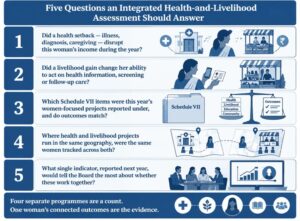
Sometimes the most valuable finding of the year is not any one programme’s individual result. It is discovering that the same women appear across a company’s health rosters and livelihood rosters — and that no one has yet asked what that overlap means.
A strong assessment should therefore be capable of producing uncomfortable findings as well as positive ones.
- If health and livelihood projects for women are funded from the same CSR budget but evaluated by different agencies using different indicators, that is important.
- If a company cannot say whether the women reached by its screening camp are the same women in its SHG programme, that is important.
- If this year’s impact assessment reads like four separate reports rather than one picture of the same women’s lives, that is important.
At BlueSkyCSR, this is the lens we’ve brought to impact assessment throughout this October series — screening, livelihoods, occupational health and survivorship — and the same lens our CSR consulting services would bring to your FY27 impact assessment. Talk to BlueSkyCSR about designing an assessment that looks at the whole woman, not just the whole programme.
Sources
- Companies (Corporate Social Responsibility Policy) Rules, 2014, Rule 8(3), as summarised by the Institute of Chartered Accountants of India (ICAI) and Samhita / Centre for Advancement of Philanthropy, ‘Impact Assessment FAQs.’
- Ministry of Corporate Affairs, Government of India, Companies Act, 2013 — Schedule VII, Items (i), (ii) and (iii).
- This edition synthesises the four preceding October 2026 editions of The BlueSkyView, published 1, 8, 15 and 22 October 2026.