

THE BLUESKYVIEW
Evidence. Impact. Better Decisions.
Her Income, Someone Else’s Say
Over 10 crore rural women have been mobilised into more than 90 lakh self-help groups under India’s national rural livelihoods mission. SHG-bank loan repayment rates exceed 96% – far higher than commercial unsecured credit. Yet a rigorous evaluation of the same mission found it did not significantly improve women’s decision-making power within the household.
Self-help groups are the backbone of women empowerment CSR in India – skilling, micro-enterprise, federation-building. But for companies funding these programmes, there is a question that headline membership numbers don’t answer, and that monitoring and evaluation exists to settle:
Does higher household income mean a woman gained decision-making power?
- A woman earning through a livelihood programme is participation.
- A woman controlling how that income is spent is agency.
- A woman able to leverage that income into wider life choices – mobility, education, health-seeking – is closer to empowerment.
And this is where CSR and livelihood impact assessment becomes important.
India’s livelihood-programme data tells two stories at once – one of scale, and one of what scale has not yet delivered.
- 3ie’s impact evaluation of India’s National Rural Livelihoods Mission found positive effects on savings and credit access, alongside only “moderate progress” on household income growth.
- NITI Aayog (2023) found SHG-bank credit access is highly skewed: Andhra Pradesh, Telangana and Tamil Nadu account for roughly 60% of all SHG credit nationally.
- An IndiaSpend review of a randomised evaluation found the mission raised income and health spending, but did not significantly change women’s agency within the household – researchers noted that “household and social norms are very hard to change.”
These developments point to an important shift: livelihood impact is increasingly being recognised not simply as a count of women mobilised or savings accumulated, but as a question of whether income actually converts into a woman’s say over her own life.
For companies, that creates an opportunity – but also a measurement challenge.
Does a livelihood-skilling programme qualify for CSR?
Skill development CSR – vocational skilling and livelihood-enhancement projects – falls under Schedule VII, Item (ii) of the Companies Act, 2013 – “employment enhancing vocation skills… and livelihood enhancement projects.” Women’s collective-building through SHG federations is more often reported under Item (iii), promoting gender equality and women’s empowerment.
Many CSR budgets report SHG-formation activity under both items without distinguishing which specific outcome – income generated, or agency gained – the funding is actually claiming credit for. That ambiguity is exactly what an independent impact assessment should resolve.
What difference is your livelihood programme making?
Most organisations begin their measurement journey by asking: “How many women joined an SHG?” We believe the better question is: “What changed in her income, her agency and her choices – and can she sustain it without external support?”
These are useful programme metrics. The further we move along this monitoring and evaluation chain, the more meaningful – and more demanding – the evidence needs to become.
- A membership count tells us how many women joined.
- A savings and credit-access record tells us whether the financial mechanism functioned.
- An income-tracking survey tells us whether earnings actually grew.
- A household decision-making assessment tells us whether that income translated into agency.
Membership becomes access. Access becomes income. Income becomes agency – but only if we measure that far.
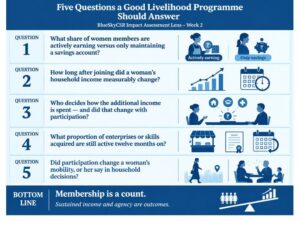
Five Questions a Good Livelihood Programme Should Answer:
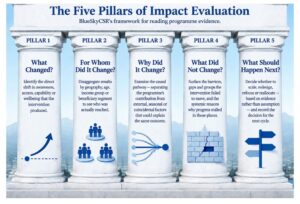
Sometimes the most valuable finding is not how many SHGs were formed. It is discovering how many have stopped meeting, or how many women still hand over their earnings without a say in how they’re spent.
A strong assessment should therefore be capable of producing uncomfortable findings as well as positive ones.
- If group formation is high but loan utilisation for productive enterprise is low, that is important.
- If income has risen but household decision-making patterns have not shifted, that is important.
- If credit access is concentrated in a handful of states while others remain excluded, that is important.
At BlueSkyCSR, this is the lens we bring to CSR impact assessment. We look beyond mobilisation numbers to examine income sustainability, agency and who gets left behind. Talk to BlueSkyCSR about designing an assessment around the decisions your evidence needs to inform.
Sources
- 3ie (International Initiative for Impact Evaluation), ‘Rural India Livelihoods Project’ (2025) – impact evaluation of India’s National Rural Livelihoods Mission (NRLM) and its enhanced phase, NRETP.
- NITI Aayog (2023), cited in PWOnlyIAS (2025), ‘Self-Help Groups’ – state-wise concentration of SHG-bank credit linkage.
- IndiaSpend (2020, updated review), ‘How Women’s Self-Help Groups Boosted Household Incomes’, citing Barooah et al. – randomised evaluation findings on income, health spending and household agency.
- Ministry of Rural Development, Government of India (2025), Deendayal Antyodaya Yojana – National Rural Livelihoods Mission (DAY-NRLM) coverage data, as cited in PWOnlyIAS (2025) and Anantam IAS (2026).
- Ministry of Corporate Affairs, Government of India, Companies Act, 2013 – Schedule VII, Items (ii) and (iii).