


THE BLUESKYVIEW
Evidence. Impact. Better Decisions.
Seen, But Never Screened
Every October, corporate India lights up pink for Breast Cancer Awareness Month — walks, ribbons, camps, social posts.
India recorded 192,020 new breast cancer cases and 98,337 deaths in a single year — close to one death for every two women diagnosed. National screening coverage for breast, oral and cervical cancer combined remains below 2%. And in its 2026 global status report, the WHO placed India in the “No programme” category for organised breast cancer screening.
But for companies funding breast-health programmes through CSR, a quieter question deserves attention:
Is raising awareness the same as enabling early detection?
- A woman recognising a breast-cancer awareness message is exposure.
- A woman knowing how and where to get screened is awareness.
- A woman who actually completes a clinical breast exam or mammogram, and returns for her result, is closer to a meaningful outcome.
And this is where CSR and breast-health impact assessment becomes important.
India’s breast-cancer data is changing, and the gap between visibility and detection is increasingly well documented.
- The GLOBOCAN 2022 estimates, analysed in a 2025 review, put India’s breast cancer mortality-to-incidence ratio at roughly 51 — meaning the disease claims close to one life for every two women it is diagnosed in.
- An ICMR National Cancer Registry Programme analysis of 76,356 women diagnosed across 71 hospital-based registries between 2009 and 2020 found that nearly 13% already had metastatic disease at the time of diagnosis.
- A 2026 BMJ Open implementation-research protocol notes that despite India’s National Programme for Prevention and Control of NCDs, screening coverage for oral, breast and cervical cancer combined remains below 2%.
These developments point to an important shift: breast-health outcomes are increasingly being recognised not simply as a function of how many women have heard the message, but as a question of whether screening systems, referral pathways and follow-through actually work.
For companies, that creates an opportunity — but also a measurement challenge.
Does a breast-health screening programme qualify for CSR?
Preventive healthcare falls squarely under Schedule VII, Item (i) of the Companies Act, 2013 — “promoting health care including preventive health care.” A well-designed screening camp is a legitimate CSR activity.
However, under Rule 2(1)(d)(iv) of the Companies (CSR Policy) Rules, 2014, activities that benefit only the company’s own employees are excluded from CSR. A screening camp open exclusively to on-roll staff, with no reach into families, contract workers or the surrounding community, sits closer to an employee-wellness benefit than a CSR initiative — a distinction that matters when the same activity is also reported under Schedule VII, Item (iii), promoting gender equality and women’s empowerment.
What difference is your screening programme making?
Most organisations begin their measurement journey by asking: “How many women attended the camp?” We believe the better question is: “What changed in their care-seeking behaviour and clinical outcomes afterward?”
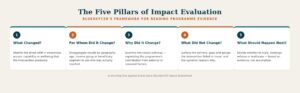
These are useful programme metrics. The further we move along this chain, the more meaningful — and more demanding — the evidence needs to become.
- A turnout count tells us how many women attended.
- A knowledge-recall assessment tells us whether the messaging was understood.
- Follow-up screening and referral-completion data tells us whether awareness converted into action.
- Diagnostic and treatment-linkage data tells us whether early detection actually occurred.
Turnout becomes awareness. Awareness becomes action. Action becomes early detection — but only if the chain is followed all the way through.
Five Questions a Good Breast-Health Programme Should Answer:
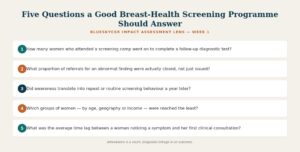
Sometimes the most valuable finding is not how many women attended a camp. It is discovering how many were lost between awareness and diagnosis — and why.
A strong assessment should therefore be able to produce uncomfortable findings as well as positive ones.
- If turnout is high but follow-up diagnostic completion is low, that is important.
- If awareness campaigns reach urban clusters while rural or informal-sector women remain unreached, that is important.
- If referrals are issued but women never return to close the loop, that is important.
At BlueSkyCSR, we bring this lens to impact assessment. We look beyond attendance numbers to examine referral pathways, follow-through and who gets left out. Talk to BlueSkyCSR about designing an assessment around the decisions your evidence needs to inform.
Sources
- Sathishkumar, K. et al. (2022); Kim et al. (2025), cited in Frontiers in Artificial Intelligence (2025), ‘Predicting and identifying correlates of inequalities in breast cancer screening uptake using national level data from India’ — GLOBOCAN 2022 incidence and mortality estimates for India.
- Sarveswaran et al., ICMR–National Cancer Registry Programme analysis, cited in ‘The Lumps We Missed: Why India Must Downstage Breast Cancer’ (PMC, 2025–26) — metastasis-at-diagnosis findings across 71 hospital-based registries, 2009–2020.
- BMJ Open (2026), ‘Enhancing screening, early diagnosis and treatment initiation of oral, breast and cervical cancer in selected districts of India: an implementation research protocol’ — national screening coverage under NP-NCD.
- World Health Organization, Global Status Report on Cancer (2026), CanScreen5 assessment, as summarised in Observer Research Foundation (2026), ‘Cancer Care in India: Reading the WHO Global Status Report 2026.’
- Ministry of Corporate Affairs, Government of India, Companies Act, 2013 — Schedule VII, Items (i) and (iii); Companies (CSR Policy) Rules, 2014, Rule 2(1)(d).