

India Spends Rs 8,739 Crore on Healthcare and Sanitation CSR. Most of It Arrives Too Late.
Healthcare and sanitation together form India’s second-largest Schedule VII CSR sector. MCA sector allocation data for FY 2022-23 put combined spend at Rs 8,739 crore, out of a total national CSR spend of Rs 29,986 crore. That is a significant number. It is also, in most programme designs, a reactive one.
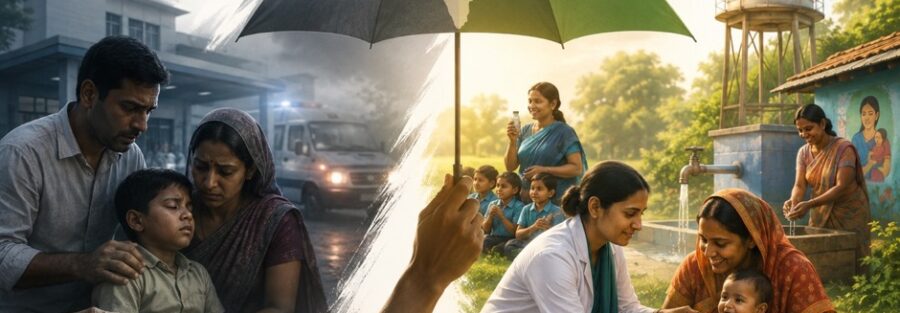
Most healthcare CSR in India is structured around delivery: medical camps, ambulance procurement, hospital infrastructure, equipment donations. These meet people at moments of acute need and fill genuine gaps in public health coverage. But they are built for the crisis after it arrives, not for reducing the conditions that produce it.
India’s National Health Accounts for FY 2021-22, published by NHSRC under MoHFW, put out-of-pocket expenditure at 39.4% of total health expenditure. This is an improvement from 47.1% in FY 2019-20 — a reduction driven by expanded public coverage under PM-JAY and the National Health Mission. Even so, 39.4% is more than double the global average of approximately 18%, as benchmarked by the World Bank. When a household member falls seriously ill, more than a third of every rupee spent on treatment falls directly on the household. The documented response: borrowing, asset liquidation, reduced food intake. WHO estimated in 2022 that high out-of-pocket health spending pushes approximately 55 million Indians below the poverty line every year.
NFHS-5 (2019-21), conducted by IIPS for MoHFW, reports full vaccination coverage for children aged 12-23 months at 76.5% nationally. Nearly one in four children in this age group remains incompletely vaccinated. Vaccine-preventable diseases continue to generate the acute demand that curative CSR is designed to meet. The pattern reinforces itself: prevention gaps produce higher emergency caseloads, which direct spend toward curative response, which leaves prevention structurally underfunded in the next cycle.
Preventive healthcare CSR asks an earlier question: what can be designed before the crisis?
In practice, this means nutrition screening for mothers and children in the first 1,000 days, the developmental window where malnutrition causes damage that later intervention cannot fully reverse. Community health worker training in disease recognition and early referral, shortening the time between symptom onset and care. Vaccine outreach in underserved blocks where NFHS-5 data identifies persistent coverage gaps. Safe drinking water infrastructure that cuts the diarrhoeal disease burden disproportionately borne by children under five. Hygiene behaviour change that reduces preventable mortality at community level.
A community health worker trained today continues identifying cases and facilitating referrals for years ahead. A clean water system reduces disease burden for the operational life of the infrastructure. Their outcomes accumulate across programme cycles in ways a one-time medical camp cannot.
The counter-argument from programme managers is real: preventive outcomes are harder to attribute, slower to surface, and less visible to internal stakeholders expecting a year-end deliverable. A child who avoided hospitalisation for a waterborne illness does not appear in any impact report. This is a genuine constraint — but it is an argument for stronger monitoring frameworks and longer programme cycles, not for concentrating spend at the curative end of the spectrum.
Companies reviewing healthcare CSR portfolios should put one direct question to every implementing partner: where does your programme sit on the prevention-to-cure spectrum, and what is your theory of change? The answer should trace the intervention logic to the health behaviour or structural condition it aims to shift, and name the indicators that will show whether that logic holds over time. If the mechanism depends on illness having already arrived, the programme is responding to a community health deficit and not reducing one.
In healthcare and sanitation, meaningful CSR is not measured only by the money that moves, but by the patience to understand what changes slowly, what works differently, and what finally makes communities healthier, safer, and more resilient.
BlueSkyCSR helps companies design and assess healthcare CSR programmes structured for outcomes, not just expenditure. Visit blueskycsr.com.