

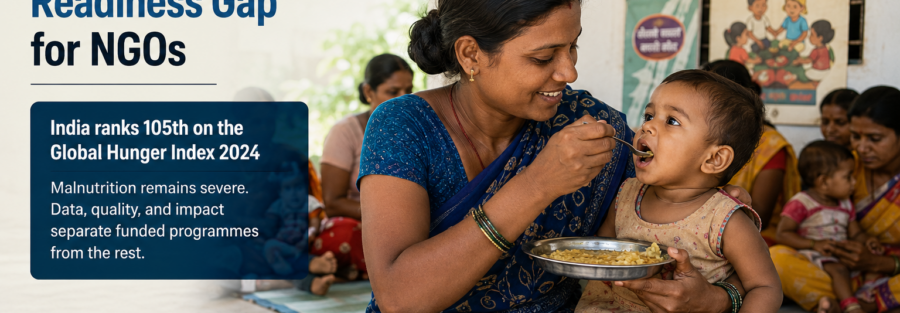
India Ranks 105th on the Global Hunger Index. Here Is What Nutrition NGOs Need to Show CSR Funders.
India’s rank on the 2024 Global Hunger Index is 105th out of 127 countries, with a score of 27.3 — placing it in the “serious” category alongside Pakistan and Afghanistan, and behind neighbours like Bangladesh, Nepal, and Sri Lanka, which fall into the “moderate” band.
The component indicators are stark. 13.7% of the population is undernourished, 35.5% of children under five are stunted, 18.7% of them are wasted, and 2.9% of children die before their fifth birthday. These are among the most severe nutrition indicators in South Asia, and they have not moved much over recent cycles — India ranked 107th in both 2023 and 2022, 101st in 2021, and 94th in 2020, meaning the country’s relative position has actually worsened over five years even as its GDP has grown.
Child wasting is worth pausing on, because it is the indicator CSR funders understand least. A wasted child is not malnourished in the slow, generational sense that stunting represents — they are losing weight-for-height right now, usually from a combination of acute infection and inadequate diet. At 18.7%, India’s wasting rate is exceptionally high for a country at its income level, and it is the indicator most sensitive to programme quality and timing, not just programme reach.
The delivery infrastructure exists. The evidence gap is what’s holding funding back.
POSHAN 2.0 (the Government of India’s consolidated nutrition mission under the Ministry of Women and Child Development) is delivered primarily through Anganwadi centres — India operates over 14 lakh (1.4 million) of these as the frontline infrastructure for supplementary nutrition to children under six and to pregnant and lactating women. Coverage, on paper, is close to universal. Quality and community engagement are not.
This is the gap CSR-funded NGOs sit in — and it’s also where corporate CSR due diligence has gotten noticeably sharper. What we’re seeing funders ask for now, consistently:
- Baseline and endline anthropometric data — weight-for-height, height-for-age — not just counts of children reached
- Behaviour change communication (BCC) components, because malnutrition in most Indian households is not purely a supply problem: it’s diet diversity, caregiving practices, and intra-household food allocation
- Male engagement strategies, particularly in communities where food purchasing and allocation decisions are made jointly or by men
- Referral pathway integration with the public health system for cases of severe acute malnutrition (SAM), rather than NGOs running parallel, disconnected treatment tracks
NGOs that can document these are increasingly the ones getting multi-year commitments rather than one-cycle grants. NGOs presenting participation counts and tonnage of food distributed are facing harder questions — not because CSR managers have become skeptical of nutrition work, but because their own boards are now asking them for outcome data, and headcounts don’t survive that conversation.
What “CSR-ready” actually means
The uncomfortable truth is that CSR-readiness and programme effectiveness are the same checklist: a clearly articulated theory of change, documented baselines, a system for tracking outcomes (not just outputs), and an honest plan for sustainability after the funding cycle ends. NGOs that build for the second usually pass the first automatically.
BlueSkyCSR works with nutrition and community health NGOs to build impact frameworks that hold up to this level of corporate scrutiny – from baseline design through to reporting formats CSR teams can actually defend to their boards. Visit blueskycsr.com to learn more.