

63 lakh teachers trained. More than 1 crore teachers in India’s school system.
These are impressive numbers. But here is the question CSR teams should be asking as part of any genuine CSR impact assessment: what changed because of that training?
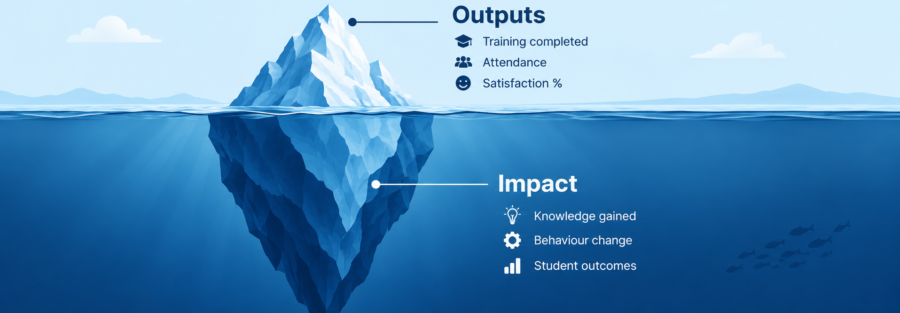
A teacher completing a training programme is an output. A teacher applying what they learned is an outcome. A student learning better because teaching improved is closer to impact.
And an impact assessment should tell us not only whether change happened, but what the evidence means for the next decision.
Start With the Decision, Not the Indicators
Most CSR programmes begin their measurement journey by asking:
“What should we measure?”
We believe the better question is:
“What decision will this evidence help us make?”
- Should we scale the programme?
- Redesign it?
- Reach a different group?
- Change the implementation approach?
- Invest differently?
A Certificate Is Not an Outcome
India’s teacher-training ecosystem operates at enormous scale. More than 63 lakh teachers were trained under different NISHTHA programmes between 2019 and 2022. Reaching teachers at scale matters.
But “teachers trained” tells us that an activity took place. It does not tell us whether the programme made a difference.
- Did teachers’ subject knowledge improve?
- Did classroom practices change?
- Did students benefit?
- Did the programme work equally well across different geographies and school contexts?
- And most importantly:
What should the CSR team do differently because of what it has learned?
A useful way to think about education CSR and CSR impact more broadly is:
Investment → Activity → Output → Outcome → Impact → Decision
Evidence informs the next CSR decision
The further we move along this chain, the more sophisticated the evidence needs to become.
- A completion certificate can establish participation.
- A competency assessment can indicate whether knowledge improved.
- Classroom observation can reveal whether teaching practice changed.
- Student-level evidence can help assess whether those changes translated into better learning.
The Numbers We Count Are Not Always the Change We Need to Understand
Imagine a CSR programme reports:
5,000 teachers trained.
95% completion.
90% satisfaction.
The programme may have been efficiently delivered. But these numbers cannot answer whether teachers became better equipped to teach.
Now imagine the assessment also finds:
- teacher competency improved;
- classroom practices changed;
- improvement was stronger in some schools than others; and
- student learning improved in the targeted competencies.
Now the CSR team has something much more valuable than a completion rate. It has evidence that can inform its next investment.
This is why impact assessment of CSR projects needs to go beyond outputs.
Five Questions a Good Impact Assessment Should Answer
- What changed? Did knowledge, capability, behaviour or access improve?
- For whom did it change? Did results differ across geography, gender, school type or beneficiary groups?
- Why did it change? What role did the programme play, and what other factors influenced the result?
- What did not change? Where did the intervention fall short – and what can be learned from that?
- What should happen next? Should the programme scale, change, continue, stop or invest differently?
The Real Value of Impact Assessment
A CSR impact assessment should not simply prove that money was spent and activities were completed. It should help a CSR team make a better decision.
Scale. Redesign. Refocus. Continue. Stop. Invest differently.
Sometimes the most valuable finding is not that a programme worked. It is discovering where it worked, where it did not, for whom it worked, and why.
That is what turns impact assessment from a reporting exercise into a strategic tool.
From “How Much Did We Do?” to “What Difference Did We Make?”
At BlueSkyCSR, this is the lens we bring to impact assessment. We look beyond outputs to examine evidence of change – connecting programme design, implementation, outcomes, stakeholder experiences and impact. Nowhere is this more relevant than in CSR and education, where the gap between activity and genuine learning outcomes is easy to overlook.
As an NABCB-accredited Type A Inspection Body under ISO 17020:2012, BlueSkyCSR brings independence, structured methodology and evidence-based assessment to CSR impact assessment.
But our starting point is always the same:
What decision does this assessment need to enable?
Because the best impact assessment is not the one that produces the longest report. It is the one that produces evidence good enough to change a decision.
Sources
1. Ministry of Education, Government of India. Over 63 Lakh Teachers Trained Under Different NISHTHA Programmes From 2019–22. Press Information Bureau / News on AIR.
2. Ministry of Education, Government of India. Unified District Information System for Education Plus (UDISE+) 2025–26 – Key Findings. Press Information Bureau, August 2026.
3. NCERT, Ministry of Education, Government of India. National Achievement Survey (NAS) 2021 – National Report Card. 2022.