

One Life, Three Line Items
Education received ₹13,877 crore, or 34%, of India’s CSR spend in FY 2024–25. Research following Indian children over time shows those stunted at age one are 22 percentage points more likely to still be stunted at fifteen, and persistent stunting has been linked to roughly 4.6 points lower IQ at age nine.
Across this month’s editions we have looked at learning, nutrition and school retention. In most companies, each of these sits in a different budget line, run by a different team and reported by a different partner. A final question connects them:
Are we funding a child’s growth, learning and schooling as one journey, or as three separate budgets?
- A nutrition project, a learning project and a school-facilities project each report their own success.
- The same child may touch all three, or none of them.
- Whether her life improved depends on how the three fit together.
And this is where a child-centred impact-assessment lens becomes important.
The evidence on how childhood unfolds is consistent, and rarely reflected in how CSR is organised.
- Healthcare received ₹8,531 crore of CSR spend in FY 2024–25, funding that sits in a separate portfolio from education even when the beneficiary is the same child.
- A study of children across four countries, including India, found that 36% of those stunted at age eight caught up by fifteen, and those who did showed smaller deficits in cognitive scores.
- Young Lives research found stunting at age one was associated with being older than expected for school grade and with lower scores in mathematics, reading comprehension and vocabulary.
These developments point to an important shift: child development is increasingly being recognised as a connected path, where what happens in early nutrition shapes what is possible in the classroom years later.
For companies, that creates an opportunity — but also a measurement challenge.
Can a child’s multi-year journey be funded as one project?
In part. The CSR Rules recognise an “ongoing project” — a multi-year initiative whose timelines do not exceed three years beyond the year it began. Under Section 135(6) of the Companies Act, 2013, any unspent balance on such a project moves to an Unspent CSR Account within thirty days of the financial year-end and must be spent within three financial years.
That structure allows a cohort of children to be followed for several years under one design. But it is a limit, not a licence: childhood outcomes that unfold over a decade do not fit neatly inside a four-year window, and few CSR portfolios are designed to follow a child across more than one project.
What would a child-centred assessment actually measure?
Most organisations begin their measurement journey by asking: “How many children did each of our programmes reach?” We believe the better question is: “For the children we reached, did anyone follow the same child from growth to learning to staying in school?”
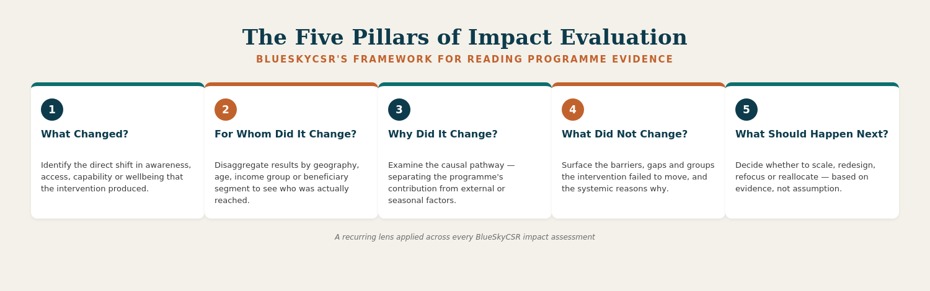 These are useful programme metrics. The further we move along this chain, the more meaningful — and more demanding — the evidence needs to become.
- Programme counts tell us what each project delivered.
- Child-level identifiers tell us whether the same children appear across projects.
- Cohort follow-up tells us what happened to them over several years.
- A comparison with children outside the projects tells us what the investment added.
Delivery becomes tracking. Tracking becomes pathway. Pathway becomes evidence — when the child, not the project, is the unit of measurement.
Five Questions a Child-Centred Assessment Should Answer:
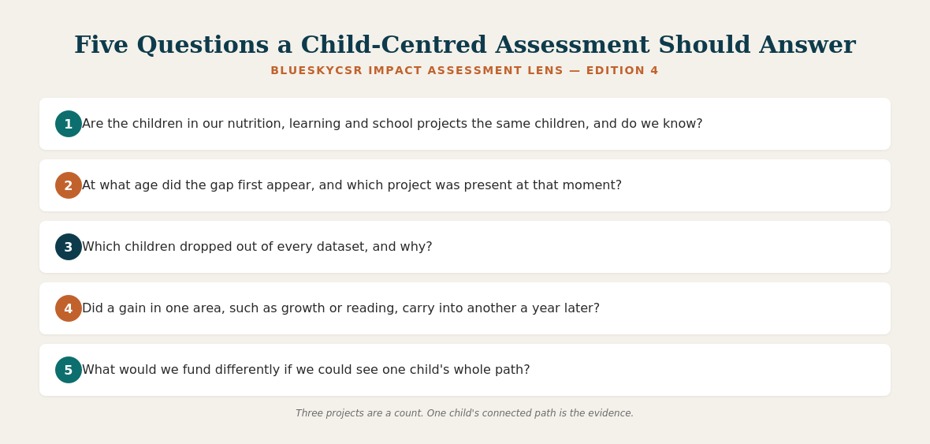 Sometimes the most valuable finding is not any single project’s result. It is discovering that three projects served the same villages for years and nobody could say whether they served the same children.
A strong assessment should therefore be capable of producing uncomfortable findings as well as positive ones.
- If projects serve the same villages but no one can say whether they reach the same children, that is important.
- If gains in nutrition are never connected to learning data, that is important.
- If the children who most need follow-up are the first to vanish from the records, that is important.
At BlueSkyCSR, this is the lens we have brought to impact assessment throughout this November series — learning, nutrition and school retention. Talk to BlueSkyCSR about designing an assessment that follows the child, not just the project.
Sources
- Fulcrum, CSR Performance Report 2026, as reported by UNI (18 July 2026), ‘India Inc’s spending on CSR hits Rs 40,794 cr in FY2024-25’, and by Swastika Investmart (2026) — education and healthcare allocations.
- Deshpande, A. and Ramachandran, R. (2020), ‘Which Indian Children are Short and Why? Social Identity, Childhood Malnutrition and Cognitive Outcomes’, Ashoka University Discussion Paper No. 27 — persistence of stunting and its link to learning outcomes.
- Hong, S.A. et al., ‘Are early childhood stunting and catch-up growth associated with school age cognition? Evidence from an Indian birth cohort’ (PMC) — cognition scores at age nine.
- Fink, G. and Rockers, P.C. (2014), ‘Childhood growth, schooling, and cognitive development: further evidence from the Young Lives study’, American Journal of Clinical Nutrition; and Crookston, B. et al. (2013), ‘Post-infancy growth, schooling, and cognitive achievement: Young Lives’.
- Ministry of Corporate Affairs, Government of India, Companies Act, 2013 — Section 135(6); Companies (CSR Policy) Rules, 2014 — definition of ‘ongoing project.’