


The Bill After the Battle
A study of breast cancer survivors in Maharashtra found 60% experienced financial hardship, with only a third holding health insurance and 43.8% self-funding treatment entirely. Separately, a study of Indian cancer survivors found treatment adversely affected the financial condition of 42% of patients. As India’s survivorship population grows, return-to-work remains an overlooked part of the recovery story.
October’s breast-cancer conversation understandably centres on detection and treatment. But for companies supporting survivors — as employees, as CSR beneficiaries, or both — there is a question that comes after the last chemotherapy session, and that impact evaluation exists to answer:
Does completing treatment mean a woman’s livelihood has also recovered?
- A survivor completing treatment is a clinical outcome.
- A survivor who returns to her workplace or enterprise is participation.
- A survivor who sustains that income and role over the following year is closer to a meaningful outcome.
And this is where CSR impact assessment — of survivorship programmes specifically — becomes important.
India’s survivorship data is only beginning to capture what happens to a woman’s income after her diagnosis.
- A mixed-methods study of 80 breast cancer survivors in Maharashtra found 60% reported financial hardship on a validated financial-toxicity scale; only a third had health insurance, and 43.8% self-funded their treatment entirely.
- A brief report on the living experiences of Indian adult cancer survivors found the diagnosis and its treatment adversely affected the financial condition of 42% of patients, with a median gap of 1.5 months before returning to daily activities.
- Reporting on India’s growing survivorship population — estimated at over 2.1 million people — has noted that return-to-work support remains an overlooked area even as more women survive the disease.
These developments point to an important shift: survivorship is increasingly being recognised not simply as the end of treatment, but as a question of whether a woman’s income, role and financial stability actually recover in the months that follow.
For companies, that creates an opportunity — but also a measurement challenge.
Does a cancer-survivor support programme qualify for CSR?
A survivor-support initiative restricted only to a company’s own diagnosed employees falls under the Rule 2(1)(d)(iv) employee-benefit exclusion — it may be excellent HR policy, but it is not CSR.
A broader initiative — financial-hardship counselling, vocational retraining, or livelihood-continuity support open to survivors in the wider community — can be reported under Schedule VII, Item (i), healthcare, read together with Item (ii), livelihood enhancement, since it bridges clinical recovery and economic recovery. This is where CSR and healthcare meet livelihood enhancement.
What difference is your survivorship programme making?
Most organisations begin their measurement journey by asking: “How many survivors were counselled?” We believe the better question is: “How many resumed and sustained their livelihood a year later?”
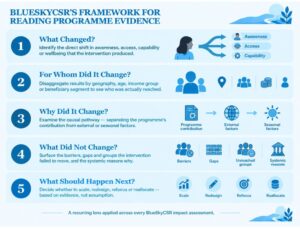
These are useful programme metrics. The further we move along this impact evaluation chain, the more meaningful — and more demanding — the evidence needs to become.
- A counselling-session count tells us how many survivors were reached.
- A return-to-work record tells us how many resumed employment or enterprise.
- An income-tracking follow-up tells us whether that livelihood was sustained.
- A financial-hardship reassessment tells us whether the underlying economic burden actually eased.
Counselling becomes return. Return becomes income. Income becomes recovery — but only if the follow-up happens.
Five Questions a Good Survivorship Programme Should Answer:
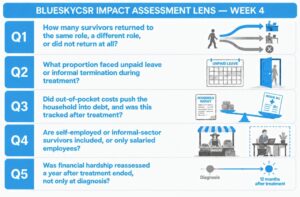
Sometimes the most valuable finding is not how many survivors attended a support session. It is discovering how many quietly lost their jobs, or never returned to work at all.
A strong assessment — and the CSR impact assessment report that follows — should therefore be capable of producing uncomfortable findings as well as positive ones.
- If counselling attendance is high but return-to-work rates are never tracked, that is important.
- If salaried employees are supported while self-employed or informal-sector survivors are left out, that is important.
- If financial hardship is assessed only at diagnosis and never revisited a year later, that is important.
At BlueSkyCSR, this is the lens we bring to impact assessment. We look beyond counselling attendance to examine sustained return-to-work and financial recovery. Talk to BlueSkyCSR about designing an assessment around the decisions your evidence needs to inform.
Sources
- PMC (2024), ‘Burden of Financial Hardship Among Breast Cancer Survivors in Maharashtra, India’ — mixed-methods study of 80 survivors using the COST-FACIT financial-toxicity scale.
- World Association of Cancer Prevention (WAOCP) journal, ‘Living Experiences of Indian Adult Cancer Survivors — a Brief Report.’
- Health Policy Watch (2026), ‘In India, Cancer Is Increasingly Costing Survivors Their Livelihoods’ — reporting on India’s survivorship population and return-to-work gaps.
- Ministry of Corporate Affairs, Government of India, Companies Act, 2013 — Schedule VII, Items (i) and (ii); Companies (CSR Policy) Rules, 2014, Rule 2(1)(d).