


THE BLUESKYVIEW
Evidence. Impact. Better Decisions.
Anemia at Work: Who’s Counting the Cost?
Nationally, 57% of Indian women aged 15–49 are anaemic — up from 53.1% five years earlier. A 2025 study of garment-factory workers in Bengaluru found 71.3% of women workers anaemic, with over 60% classified as moderate or severe. And despite a dedicated national programme since 2018, anaemia prevalence has risen, not fallen. For companies funding worker health, that makes CSR impact assessment more than a reporting formality.
Worker wellness camps, iron-folic-acid distribution and health check-ups are common CSR and workplace-health activities. But for companies running them, there is a question turnout registers don’t answer:
Does a wellness camp mean a worker’s health has actually improved?
- A worker attending a health camp is participation.
- A worker being tested and told her haemoglobin level is awareness.
- A worker whose haemoglobin measurably improves over time, and who reports less fatigue at work, is closer to a meaningful outcome.
And this is where CSR and occupational-health impact assessment becomes important.
India’s data on women’s occupational health is moving in a direction the country’s own nutrition programme did not intend.
- National Family Health Survey data shows anaemia among all women aged 15–49 rose from 53.1% (NFHS-4) to 57.0% (NFHS-5) — an increase, despite the Anaemia Mukt Bharat programme launched in the interim.
- A 2025 cross-sectional study of female garment workers in Bengaluru recorded an anaemia prevalence of 71.3%, with 52.9% classified as moderate and 9.8% as severe, and linked the burden to long working hours and workplace conditions.
- The same study identified low socioeconomic status, inadequate dietary intake and poor workplace conditions as significant risk factors — not supplementation coverage alone.
These developments point to an important shift: worker wellbeing is increasingly being recognised not simply as a count of tablets distributed, but as a question of whether working conditions, nutrition and follow-up testing actually change a worker’s measurable health status.
For companies, that creates an opportunity — but also a measurement challenge.
Does a worker health and nutrition programme qualify for CSR?
A health or nutrition initiative aimed at a company’s own workforce and restricted purely to employees on its rolls falls under the Rule 2(1)(d)(iv) exclusion — the same employee-benefit exclusion that applies to internal safety and wellness spending. It is good practice, not CSR.
To qualify under CSR Schedule VII, Item (i), preventive-healthcare and nutrition programmes need to extend beyond the direct payroll — to contract and informal workers not on the rolls, to workers’ families, or to the surrounding community through anganwadi or primary-health-centre linkages. Many supply-chain-linked worker-wellness budgets miss this distinction entirely.
What difference is your worker health programme making?
Most organisations begin their measurement journey by asking: “How many iron-folic-acid tablets were distributed?” We believe the better question is: “Did haemoglobin levels, absenteeism and fatigue actually change?”
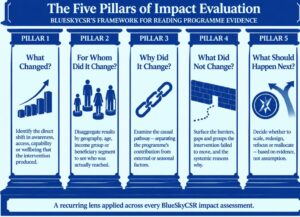
These are useful occupational health programme metrics. The further we move along this chain, the more meaningful — and more demanding — the evidence needs to become.
- A distribution count tells us how many tablets or supplements were given out.
- A screening record tells us how many workers were tested.
- A compliance-tracking survey tells us whether workers actually consumed the supplementation as prescribed.
- A repeat haemoglobin test tells us whether health status genuinely improved.
Distribution becomes testing. Testing becomes compliance. Compliance becomes measurable health change — but only if the follow-up test happens.
Five Questions a Good Worker Health Programme Should Answer:
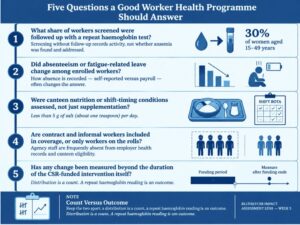
Sometimes the most valuable finding is not how many tablets were distributed. It is discovering how many workers never took them — or why anaemia persists despite years of the same intervention.
A strong assessment should therefore be capable of producing uncomfortable findings as well as positive ones.
- If distribution is high but compliance and repeat testing are never tracked, that is important.
- If permanent staff show improvement while contract workers on the same shop floor are excluded from the programme, that is important.
- If shift length, canteen nutrition and workload are never assessed alongside supplementation, that is important.
At BlueSkyCSR, this is the lens we bring to CSR impact assessment. We look beyond distribution counts to examine compliance, coverage and measurable health change. Talk to BlueSkyCSR about designing an assessment around the decisions your evidence needs to inform.
Sources
- National Family Health Survey-5 (2019–21), as cited in Rajya Sabha Unstarred Question No. 913, Ministry of Health and Family Welfare (11 February 2025) — anaemia prevalence among women aged 15–49, compared with NFHS-4.
- IJCMPH (International Journal of Community Medicine and Public Health), 2025, cross-sectional study of anaemia among female garment workers, Bengaluru Urban.
- Ministry of Health and Family Welfare, Government of India — Anaemia Mukt Bharat (AMB) strategy and ‘6x6x6’ life-cycle intervention framework.
- Journal of Health Science and Medical Research (2026), ‘Anaemia Trends Among Indian Women’ — trend analysis of NFHS data by state.
- Ministry of Corporate Affairs, Government of India, Companies Act, 2013 — Schedule VII, Item (i); Companies (CSR Policy) Rules, 2014, Rule 2(1)(d).