

What If Healthcare CSR Is Funding the Wrong Season?
The monsoon does not cause the most damage. The weeks after it do – and that is precisely when most healthcare CSR budgets have already been spent.
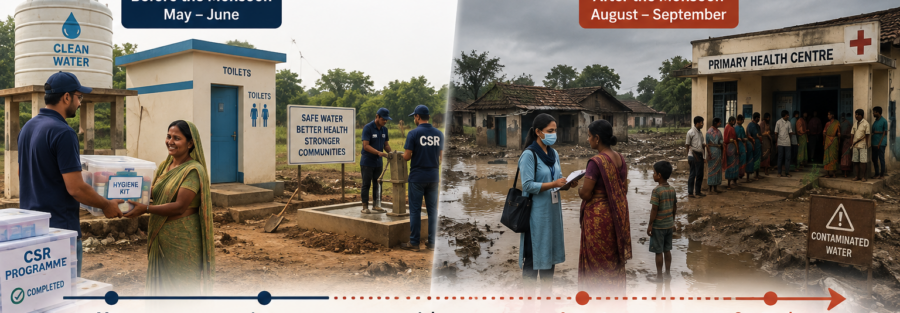
Corporate Social Responsibility in healthcare has typically followed a predictable rhythm: fund the toilets, the borewells, the hygiene kits, before the rains arrive. It’s a sound instinct. Prevention ahead of a known risk is good design. But it may also be solving for the wrong moment in the calendar – treating the monsoon itself as the hazard, when the real damage is often done in its aftermath.
Waterborne disease in India is not a new or occasional problem; it is a structural, recurring feature of the public health calendar, and the data behind it is significant enough that it deserves to be treated as core CSR risk data, not a seasonal footnote.
18.28 crore
Acute Diarrhoeal Disease cases, 2005–2022, 36,542 deaths
2.48 crore
Typhoid cases, 2005–2022, 6,465 deaths
~70%
of India’s disease outbreaks are waterborne in origin
Figures are from Dataful’s analysis of government surveillance data, with the outbreak-share estimate drawn from the Ministry of Health & Family Welfare’s public health advisories – which means this isn’t a niche WASH concern, it’s close to three-quarters of the country’s entire outbreak burden.
What if the real vulnerability window isn’t the monsoon itself, but the weeks that follow it?
The surveillance data compiled by Dataful suggests exactly that. Case surges in diarrhoeal disease, typhoid, and hepatitis A tend to peak in August and September – after flooding has already contaminated water sources and displaced sanitation systems, not during the initial onset of rain in June and July. That distinction matters more than it might seem: it means the disease burden is a downstream consequence of infrastructure failure under stress, not simply a byproduct of rainfall. The same dataset shows this pattern playing out regionally, and unevenly – these aren’t uniform national averages, they’re concentrated regional hotspots, which is itself a signal for where post-monsoon healthcare CSR should be geographically weighted, rather than distributed evenly across a national footprint.
| State | Acute Diarrhoeal Disease cases (2005–2022) | Deaths |
| West Bengal | 3.35 crore | 8,345 |
| Andhra Pradesh | 2.65 crore | 4,362 |
| Uttar Pradesh | 1.76 crore | 7,399 |
Yet many corporate healthcare CSR programmes are still designed around a pre-monsoon calendar: distribute the kits, build the infrastructure, declare the intervention complete before the rains even begin. That approach treats the monsoon as a single event to prepare for, rather than the opening of a multi-week window of elevated risk. If Dataful’s surveillance-data analysis is right that the disease burden actually peaks after the water recedes, is a pre-monsoon-only programme truly addressing the risk it was designed for – or is it addressing the risk that’s easiest to schedule around, rather than the one the data actually describes?
This is not an argument against pre-monsoon investment – infrastructure built before the rains remains essential, and none of this should be read as a case for doing less. It’s an argument for extending the CSR calendar to match the disease calendar, rather than the fiscal or reporting one. In practice, that means stocking ORS and zinc ahead of the August–September surge rather than assuming pre-monsoon distribution covers it; intensifying community health worker deployment through the post-monsoon window, when case counts are actually climbing; testing drinking water after flood events rather than only before them, since contamination risk changes the moment flooding occurs; and strengthening referral pathways so that outbreaks are caught and escalated before they become the kind of numbers the Ministry of Health & Family Welfare tracks at a national level.
Consider what this looks like in practice. A WASH-focused CSR programme that only distributes filters and builds latrines in May has done useful work – but on the evidence in Dataful’s dataset, it has not necessarily reduced the September spike in typhoid admissions at the local primary health centre, because that spike is driven by post-flood contamination the May intervention never touched. A programme that layers in post-flood water testing and a stocked community health worker network through September is addressing the actual shape of the risk described in the surveillance data, not just its symbolic season. This is where Social Impact Assessment becomes essential, helping organisations evaluate whether interventions are aligned with the periods of greatest community need rather than only with implementation timelines.
At BlueSkyCSR, our work assessing healthcare and WASH programmes has repeatedly shown that impact is less about which quarter the spend occurs in, and more about whether the intervention is timed to when the community actually needs it. In one recent programme assessment we conducted, a client’s WASH intervention had disbursed nearly its entire annual budget by June, yet the district’s own health records showed diarrhoeal admissions climbing through August and September, well after the programme had formally closed out—a mismatch between the spending calendar and the disease calendar that no amount of pre-monsoon activity could correct after the fact. A programme that is well-funded but poorly timed can still miss the disease it was designed to prevent – and no amount of pre-monsoon spend fully substitutes for post-monsoon presence, if the surveillance data is telling us that’s where the burden actually falls. Rethinking the timing of these CSR Activities can help organisations respond more effectively to the realities reflected in public health data.
Perhaps the most useful question for any healthcare CSR team this month is not “did we spend before the monsoon,” but “will our programme still be protecting people in September, when the data says the real surge begins.” Extending interventions beyond the rainy season is not only about better health outcomes—it also contributes to the long-term Sustainability of community healthcare programmes. Talk to us before finalising this year’s post-monsoon plan.