

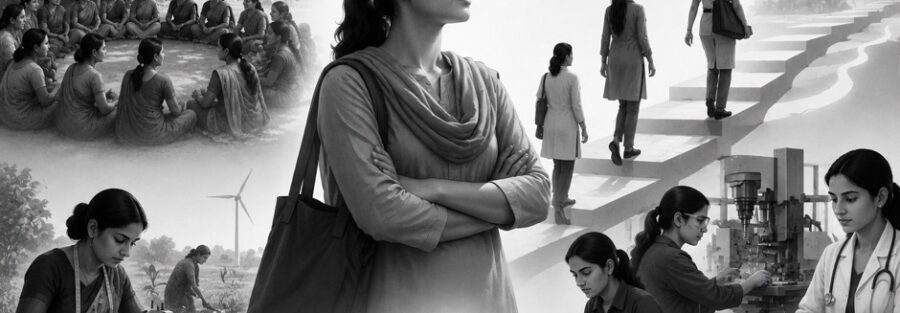
Ten crore rural women in India now belong to a Self Help Group. The Ministry of Rural Development told the Lok Sabha in October 2024 that DAY-NRLM has mobilised 10.05 crore women into roughly 90.87 lakh SHGs, a scale of community institution-building with no real parallel anywhere else in the world. Set against this, the female labour force participation rate stands at 41.7%, compared to 78.8% for men (PLFS 2023-24, MOSPI). Women are inside the system in unprecedented numbers. The economic outcomes have not caught up at the same pace.
The same PLFS data shows the gap does not close once women start earning. Self-employed men earn roughly three times what self-employed women do. Salaried men earn about 1.2 times more than salaried women. Women in high-skill jobs requiring specialised training, the exact category most CSR vocational programmes are designed to feed into, earn around 34% less than men in equivalent roles. India’s rank on the UNDP Gender Inequality Index improved to 108 out of 166 countries in the 2023-24 Human Development Report, up from 122 the year before. That is real movement, but movement from a position that started a long way behind.
The government’s own data on graduation rates within DAY-NRLM makes the same point from a different angle. Of the 10.05 crore women mobilised into SHGs, 1.15 crore have crossed the Lakhpati Didi threshold of earning at least Rs 1 lakh a year, according to the same Lok Sabha reply. That is a meaningful achievement, and it is also a graduation rate under 12%. Most women inside the institution have not moved through it into a measurably different income bracket. The institution exists. For the large majority, the income transformation it was built to enable has not yet followed.
International Widows’ Day fell on June 23 this year, and the timing is a useful prompt for this conversation. The 2011 Census counted 43 million widowed women in India, a population comparable to a mid-sized country, and 7.4% of all Indian women are widows against 1.8% of men who are widowers. A meaningful share of them are of working age rather than elderly, since India’s widowed population skews younger than in most countries. A livelihood programme designed around the assumption of a household with two working adults, or income earned alongside a husband’s, excludes this group structurally before enrolment even opens.
This is the pattern running through a significant share of women empowerment CSR: equating participation with progress. A woman who completes a vocational training programme and cannot access a client base, a credit line, or safe transit to where the work actually is has not been economically empowered. A woman who finishes a healthcare sector certification but finds no hostel support in the city where the jobs exist, and whose family will not approve of relocation, is in the same financial position after the programme as before it. The certificate exists. The income does not follow.
Gender-smart CSR design asks different questions before a programme is approved, not after it underperforms. What specific structural barrier, beyond skill, is this programme meant to address? Is there a provision for women who face family pushback after enrolment? Does the placement plan account for safe transit and accommodation, or does it end at the certificate? Is a six-month and twelve-month follow-up cycle built into the budget, or does monitoring stop the day training ends?
The women who hold onto income gains from CSR programmes a year out tend to be in programmes that addressed mobility constraints, built market linkages, and created peer support networks alongside the training hours, not training hours on their own. DAY-NRLM’s own impact evaluation found a 19% increase in beneficiary incomes over baseline, a result tied as much to the SHG’s collective bargaining power and credit access as to any single skill imparted in a classroom. The institution around the woman did as much work as the training did.
Companies running women empowerment CSR can build programmes that hold up against this kind of scrutiny. It takes longer timelines than a single financial year, more deliberate intake design, and a willingness to measure agency and economic confidence alongside enrolment numbers. None of this is a reason to scale back ambition. It is a reason to design with more precision about what is actually keeping women out, rather than assuming that getting them into a room is the same as getting them into the workforce.
BlueSkyCSR works with companies to design and assess gender-responsive CSR programmes that go beyond participation metrics, using India-specific structural data to identify where a programme will hold and where it will quietly fail six months after the photographs are taken.