

Is disability the biggest blind spot in your CSR strategy?
1.3 billion people with disabilities and their families represent a $13 trillion global market (WEF/Valuable 500), yet disability receives a fraction of corporate social responsibility budgets in India and globally. Education and healthcare dominate. Disability gets overlooked. Our new analysis shows why that happens and exactly how companies can convert intention into impact. Click to read the full breakdown.
Start with three numbers. 1.3 billion people — 1 in 6 globally — live with a significant disability. Their families and caregivers represent $13 trillion in combined spending power. And yet in India, where total mandated CSR spending reached Rs 17,967 crore in FY 2023-24, nearly 75% flowed to just three sectors: education, healthcare, and rural development. Disability-specific programming barely registers as a standalone category in national reporting.
This is not a niche oversight. It is a systemic gap with a clear business case for closing it — and a legal framework that already enables action.
Why Disability Inclusion Is a Business Imperative, Not Charity?
The economic rationale is clearer than most CSR teams realise. Working-age adults with disabilities in the United States alone hold approximately $490 billion in disposable income — comparable to other major demographic segments tracked by marketers. Globally, the Valuable 500 cites $8 trillion in direct disposable income for persons with disabilities, rising to $13 trillion when their broader social networks are included.
Brand loyalty follows accessibility. Research from the Return on Disability Group suggests brands that prioritise disability inclusion see measurably higher customer retention, with family and friends of persons with disabilities amplifying returns beyond the primary consumer group.
On talent, Microsoft’s Neurodiversity Hiring Program offers an instructive case. Recruiting individuals on the autism spectrum and with other cognitive differences, Microsoft credits the programme with fostering innovations including Eye Control in Windows, Seeing AI, and the Xbox Adaptive Controller. Six-plus years in, managers report improvements in inclusive team culture well beyond the neurodiverse hires themselves.
The cost of exclusion is equally stark. The ILO estimates that 80–90% of working-age persons with disabilities in developing countries are unemployed. India’s Census 2011 data shows only about one-third of persons with disabilities are in the workforce. That productivity gap is a problem well-designed CSR can begin to close.
“The global disability community and its networks represent $13 trillion in spending power. Companies that ignore this demographic are not being socially responsible. They are being commercially irrational.” – World Economic Forum / Valuable 500, 2023
The Indian Context: A Large Gap, Poorly Measured
India’s official count of 26.8 million persons with disabilities (Census 2011) already makes it one of the largest disability populations in the world. When a functional definition is applied, the World Bank estimated 5–8% of India’s population could qualify. Post-pandemic and with a delayed census, the true current figure is almost certainly significantly higher.
On the CSR side, the legal architecture is unambiguous. Schedule VII of the Companies Act, 2013 explicitly names “differently abled” persons as a target group. The Rights of Persons with Disabilities Act, 2016 expands the recognised disability categories from 7 to 21. Government schemes – ADIP for assistive devices, the UDID system, Divyangjan Swavalamban Yojana – provide ready-made frameworks that corporate CSR can co-finance or supplement.
The problem is measurement. Disability does not appear as a separately tracked line item in the Ministry of Corporate Affairs’ national CSR reporting portal. Without a disaggregated reporting category, national accountability for disability CSR spend is effectively impossible. Based on a reasoned triangulation of published data, disability-specific CSR allocations likely sit well under Rs 100-150 crore nationally against total spend of nearly Rs 18,000 crore. The confidence interval on that figure is wide – which is itself a problem.
Sarthak Educational Trust + Kotak Mahindra Bank (India)
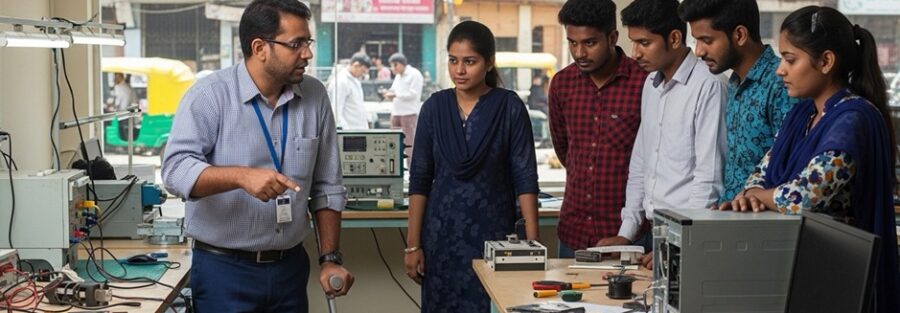
Sarthak Educational Trust, a Delhi-based NGO founded in 2008, has trained over 100,000 youth with disabilities across 30+ cities in skill development, job placement, and digital literacy. Kotak Mahindra Bank partnered with Sarthak under its CSR programme in Bhopal, West Delhi, Gurugram, and Jaipur in FY 2022-23, funding a structured three-month training programme in communication, IT, retail, and e-commerce skills.
Programme outcomes show that beneficiaries have secured placements with leading national employers, earning Rs 5,000–10,000 per month — a 3–5x increase over pre-programme earnings for most participants. The JEET (Job Entrepreneurship and Empowerment Training) model has been documented and is replicable at scale. Sarthak’s RozgarSarathi job portal further extends this impact by offering a free employment board for persons with disabilities across the country.
Microsoft’s Disability Inclusion Ecosystem (Global)
Microsoft integrates disability inclusion across workforce practices, product design, and community investment – rather than treating it as a standalone CSR project. Its Supported Employment programme places individuals with intellectual and developmental disabilities in roles across its campus ecosystem. Its Neurodiversity Hiring Programme has directly hired 150+ neurodiverse full-time staff and trained over 1,000 managers in neurodiversity in the workplace.
The lesson Microsoft offers is about time horizon. The most durable results came from embedding disability inclusion into core HR and product pipelines over six-plus years, not from annual pilot projects. That lesson applies directly to how corporate India structures its CSR commitments in this space.
Why Disability Stays Underfunded?
Despite the legal hooks and commercial logic, disability consistently finishes near the bottom of CSR priority lists. The reasons are structural. Many disabilities are non-visible, making them harder to photograph for an annual report. There is no standardised national data on CSR spend in the area, so accountability is minimal. Most CSR programmes run for one to two years, while meaningful disability inclusion – employment outcomes, accessibility retrofits, assistive technology adoption – requires multi-year commitment. The disability NGO sector in India is fragmented and often under-resourced, making it difficult for CSR teams to identify partners who can absorb large grants and produce credible impact data.
A 2021 content analysis of 129 global CSR reports found that while disability-related activity increased from 2018 to 2021, it remained the least-tracked DEI dimension relative to gender and race/ethnicity. Disability is still frequently treated as a welfare issue rather than a strategic inclusion priority.
High-Impact Interventions
Several intervention types offer strong evidence of impact and reasonable cost-effectiveness. Assistive technology programmes – hearing aids, wheelchairs, screen readers, communication devices – directly enable workforce and educational participation. A community accessibility audit followed by a phased upgrade programme for schools or public buildings offers high visibility and direct community benefit. The Sarthak/Kotak skilling model provides a tested template for employment-focused programmes in tier-2 and tier-3 cities, deliverable for approximately Rs 15,000–25,000 per beneficiary based on published programme data.
Digital accessibility is arguably the lowest-hanging fruit available. Achieving WCAG 2.1 AA compliance for a medium-sized corporate website typically costs Rs 2-8 lakh – a fraction of most CSR budgets – and removes barriers for 16% of potential users while reducing growing legal and reputational exposure as RPWD Act enforcement matures.
Eight Recommendations
The following represents BlueskyCSR’s independent analysis, intended to move the conversation from acknowledgement to action.
First, advocate for a disaggregated CSR reporting category. The Ministry of Corporate Affairs should add “empowerment of persons with disabilities” as a named Schedule VII sub-category with its own reporting field. Without this, national accountability remains impossible. Second, apply a disability-first design test to all CSR interventions: before approving any programme in education, healthcare, or livelihoods, ask whether it explicitly reaches persons with disabilities. If not, redesign it.
Third, commit to three-year minimum programme cycles. One-year pilots produce one-year results. Fourth, treat disability-led organisations as strategic partners, not grant recipients – bringing them into CSR strategy conversations, not just programme delivery. Fifth, measure employment quality, not just placement numbers. Any employment-focused disability programme should mandate 12-month beneficiary follow-up as a contractual condition.
Sixth, use digital accessibility as a credible first step that builds internal disability confidence before tackling more complex community programmes. Seventh, build cross-sector disability CSR consortia. No single company has the capital or partner relationships to move the needle at scale; sector-wide pools offer dramatically better return on social investment than isolated initiatives. Eighth, link disability CSR performance to executive ESG compensation. Companies that add disability-specific KPIs to long-term incentive scorecards embed accountability at board level – the only place where multi-year commitments are genuinely protected from budget cycles.
“In developing countries, 80-90% of working-age persons with disabilities are unemployed. Well-designed CSR skill programmes offer some of the highest social return on investment available in the development sector.” – ILO
The Bottom Line
The business case for disability-inclusive CSR is solid. The legal framework in India already enables it. The measurement gap is real but fixable. And the execution gap – between the 1.3 billion people who live with disabilities globally and the fraction of corporate CSR budgets directed toward them – is one that companies with genuine inclusion ambitions can no longer credibly ignore.