

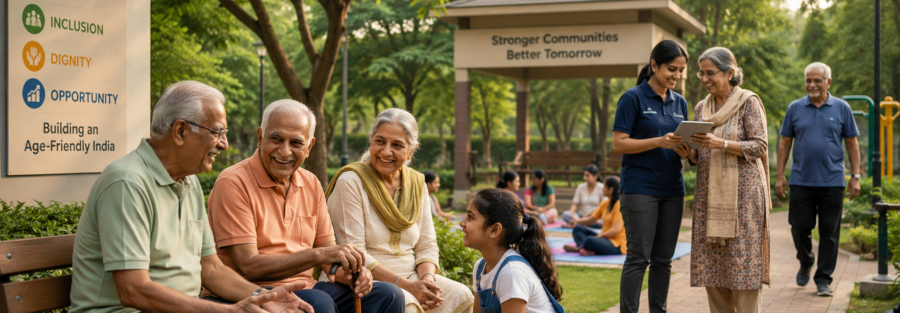
For decades, Corporate Social Responsibility (CSR) in India has focused on preparing the future – educating children, strengthening livelihoods, improving healthcare, and building resilient communities. These investments have transformed lives and contributed significantly to the country’s development journey. Much of this investment has been driven by India’s demographic dividend – a young population powering economic growth. As that demographic profile evolves, CSR too must respond to the opportunities and needs of an ageing society.
But as India’s demographic landscape changes, another question is beginning to emerge.
Who is preparing the country for the people who have already helped build it?
India is often recognised as one of the world’s youngest nations. Yet, it is also experiencing one of the world’s most significant demographic transitions. According to the UNFPA and Observer Research Foundation’s 2025 report, UHC for the Silver Dividend, India is expected to have 193 million people aged 60 years and above by 2030 – nearly doubling to 347 million by 2050, By 2050, that number is projected to reach 347 million, accounting for more than 20% of the country’s population. The UNFPA India Ageing Report 2023 further projects that by the mid-2040s, older adults will outnumber children aged 0–15 years for the first time in the country’s history. Despite this shift, ageing remains relatively underrepresented within many CSR portfolios.
Rather than viewing this shift solely as a growing social challenge, the UNFPA and ORF describe it as India’s “Silver Dividend” – an opportunity to create systems that enable older adults to remain healthy, active, and engaged in society. Realising this opportunity, however, requires long-term investments that extend beyond healthcare. Unlocking this silver dividend could mean enabling older adults to remain economically active, mentor younger generations, strengthen community leadership, and reduce long-term care burdens.
As India’s development priorities evolve, shouldn’t CSR evolve alongside them? Just as CSR priorities have evolved alongside India’s development journey, healthy ageing represents a natural next frontier.
For generations, elder care in India has largely been anchored within families. However, rapid urbanisation, migration, smaller family structures, and changing employment patterns are reshaping traditional caregiving systems. Increasingly, older adults face interconnected challenges that extend beyond healthcare, including financial insecurity, social isolation, digital exclusion, mobility constraints, and limited access to long-term care. With younger family members increasingly migrating to cities for education and employment, many older adults are left with reduced day-to-day caregiving support.
Research increasingly suggests that healthy ageing depends on much more than healthcare alone. The World Health Organization’s Decade of Healthy Ageing (2021–2030) identifies age-friendly communities, social participation, financial security, accessible services, and supportive environments as essential to enabling older adults to live healthy and dignified lives. In other words, ageing is no longer solely a healthcare challenge – it is a community development challenge. Healthy ageing is inherently cross-sectoral, making it well aligned with CSR’s integrated approach to community development.
Evidence increasingly suggests it should. Ageing intersects with healthcare, livelihoods, digital inclusion, accessibility, and community infrastructure – areas where CSR already creates measurable impact.
Many CSR programmes across India already invest in the very building blocks that support healthy ageing, even if they are not explicitly designed as elder care initiatives. This means organisations can embed ageing considerations into existing programmes rather than creating entirely new CSR portfolios.
Consider a semi-urban community where a CSR initiative initially focuses on strengthening primary healthcare services. Over time, the programme expands to include preventive health screenings for senior citizens, digital literacy sessions that help older adults access telemedicine and government benefits, caregiver awareness workshops, and community volunteers who regularly visit elderly individuals living alone. Although the initiative is not branded as an elder care programme, it strengthens multiple dimensions of healthy ageing while reducing social isolation and improving access to essential services.
Across sectors, CSR initiatives are also supporting preventive healthcare, nutrition, mental health, digital inclusion, accessible infrastructure, community centres, financial literacy, and intergenerational engagement. When designed as integrated interventions rather than standalone projects, these programmes create ripple effects that improve not only the independence and quality of life of older adults but also the resilience of the communities in which they live.
Perhaps the question is not whether CSR can support elder care – but whether many CSR programmes are already contributing to healthy ageing without recognising the broader impact they create.
Recognising the growing needs of an ageing population, the Government of India introduced the Atal Vayo Abhyuday Yojana (AVYAY) to strengthen services for senior citizens through integrated care, elder helplines, awareness initiatives, and programmes that promote active and dignified ageing. While AVYAY has strengthened institutional support, the scale of India’s demographic transition means that government efforts alone cannot meet the growing demand. For CSR practitioners, AVYAY also creates opportunities to complement public efforts through partnerships, convergence models, and community-level implementation.
The HelpAge India 2024 report, Ageing in India: Exploring Preparedness & Response to Care Challenges found that many older adults remain underprepared for ageing, particularly in areas such as healthcare access, financial planning, and awareness of support services. The India Intergenerational Bonds (INBO) Report 2025 further highlights how migration, changing family structures, and declining intergenerational interaction are increasing loneliness while weakening traditional support networks. The report notes that many older adults lack adequate preparedness across these dimensions, underscoring the need for preventive interventions before vulnerabilities deepen.
Can public programmes alone build an age-friendly India if communities themselves are not prepared for demographic change?
The answer lies in collaboration. Governments provide policy direction, civil society organisations understand community needs, and businesses—through strategic CSR investments – can strengthen the systems that enable older adults to age with dignity, independence, and security. By investing in preventive healthcare, caregiver support, accessible infrastructure, digital inclusion, community engagement, and age-friendly environments, CSR can complement public initiatives while creating lasting social impact.
At Blue Sky CSR, our work across diverse CSR programmes has consistently highlighted that the most sustainable impact comes from recognising how social challenges intersect rather than addressing them in isolation. Whether strengthening healthcare, promoting digital inclusion, supporting caregivers, improving accessibility, or building community resilience, integrated interventions often create ripple effects that extend far beyond their immediate objectives. Preparing India for an ageing population is not simply about creating programmes for senior citizens – it is about designing communities where every generation can thrive. For example, healthcare and digital inclusion initiatives have often improved older adults’ access to telemedicine, government services, and community support networks even when these projects were not originally designed as elder-care programmes.
As CSR continues to evolve, its greatest contribution may not lie in responding to the challenges of an ageing society after they emerge, but in helping communities prepare for them today.
Perhaps the true measure of a progressive society is not only how it invests in its future generations but also how it enables older generations to age with dignity, security, and purpose. A truly inclusive development journey is one that supports people not only at the beginning of life, but throughout its entire course. Now is the time for CSR leaders to integrate ageing considerations into programme design and impact assessment.