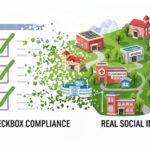



Most organisations do not have a Monitoring & Evaluation problem. They have a sequencing problem.
The M&E report gets written at the end of the project cycle. A consultant is brought in. Available data is stitched together. The report is submitted.
And the cycle repeats.
This is not monitoring and evaluation.
This is retrospective documentation.
And the distinction matters—because increasingly, funders, boards, and auditors are not just asking what happened, but whether what is being claimed can be stood behind.
The Shift: From Reporting to Credibility
What is changing is not just the expectation of measurement—it is the expectation of credibility.
Across CSR portfolios and nonprofit programmes, there is a visible shift toward:
- Clarity on what changed vs what was done
- Evidence that connects activities → outcomes → impact
- Confidence that the organisation understands its own programme, not just reports on it
In practice, our work at BlueSkyCSR has shown us that many organisations invest heavily in reporting formats, while the underlying systems that generate credible evidence remain underdeveloped.
This creates a simple but powerful distinction:
Is your M&E system producing decision-grade signals, or just reporting-grade summaries?
If your system cannot answer:
- What changed, for whom, and compared to what baseline
- What is working vs not working during implementation
- What you would do differently next time
Then you do not have an evaluation system. You have activity tracking.
When M&E is treated as a reporting obligation, everything gets designed backwards—from the report.
What does the funder want to see?
What outputs were planned?
What can be counted?
This produces a familiar structure:
- Outputs are verified
- Outcomes are inferred
- Impact is asserted
The report looks complete.
The system behind it is not.
The correct sequence is non-negotiable:
Theory of Change → Indicators → Data Collection → Analysis → Reporting
Across many programmes, a recurring pattern emerges—reporting templates exist, but the logic connecting indicators to outcomes is weak or inconsistent.
In one large-scale programme, for instance, end-of-cycle data showed limited clarity on outcomes. The issue was not the absence of data, but the absence of early signals—participant engagement, delivery quality, and implementation consistency were never tracked in a structured way.
By the time outcomes were measured, there was no way to explain why results varied.
When reporting becomes the starting point, the system loses its ability to explain reality.
The Five Components That Actually Constitute an M&E System
An M&E system is not a report, a dashboard, or a role.
It is a set of interdependent components that need to work together.
Most breakdowns do not happen in a single component—but in the gaps between them.
1. Monitoring
Continuous visibility into implementation.
Not annual tracking—real-time signals:
- Are activities happening as planned?
- Are there early signs of deviation?
In many cases, what is called “monitoring” is periodic documentation. Without real-time visibility, course correction becomes difficult.
2. Evaluation
Evaluation requires intentional design:
- A baseline measurement
- Clearly defined indicators (output, outcome, impact)
- An endline measured against the same baseline
In practice, endlines are often presented without a credible baseline—making it difficult to establish what has actually changed.
3. Learning
This is where most systems break down.
Data gets collected. Reports get created.
But decisions do not change.
Learning means:
- Interpreting data
- Asking what it implies
- Changing programme design accordingly
Organisations that build strong systems tend to institutionalise reflection cadences—not just reporting cycles.
Without this layer, M&E remains descriptive, not directional.
4. Data Systems
Tools matter less than design.
Whether using KoBoToolbox, ODK, or a custom MIS, the real question is:
Does your system capture what actually matters?
Effective systems ensure:
- Disaggregation (gender, geography, cohort)
- Consistency in data capture
- Traceability from activity to outcome
A common failure mode is collecting large volumes of data that cannot meaningfully inform decisions—creating the appearance of rigour without its substance.
5. Reporting
Reporting is the output of a functioning system.
Not the system itself.
A strong report reflects:
- Clarity of design
- Strength of data
- Integrity of analysis
If the system is weak, the report cannot compensate for it.
The Training Gap Nobody Is Addressing
The most common response to weak M&E is:
👉 “Let’s hire an M&E officer.”
This rarely solves the problem.
Because M&E is not a role.
It is a distributed capability.
- The field staff collecting data is making judgement calls
- The programme manager is interpreting patterns
- Leadership is framing claims
In many organisations, the credibility of impact claims is shaped less by tools—and more by whether each layer understands what the data means and why it matters.
If M&E is treated as compliance, it behaves like compliance.
If it is treated as a decision system, it begins to shape how programmes are run.
What “Evaluation-Ready” Actually Looks Like
An evaluation-ready organisation does not start with a report.
It starts with system clarity.
In practice, such organisations tend to have:
- A clearly articulated Theory of Change
- Indicators defined before implementation begins
- Baseline data captured early
- Data collection embedded into programme processes
- Regular review cadences for interpreting data
- Leadership willing to adapt based on evidence
In these systems, reporting becomes straightforward—because the work of understanding has already been done.
Credibility Is Built Before the Report
The gap in most M&E systems is not intent.
It is system design.
Organisations want to demonstrate impact.
But they invest in reporting, not in the conditions that make impact measurable.
And that gap shows.
Because ultimately, credibility is not built in the report.
It is built in the system that produces it.