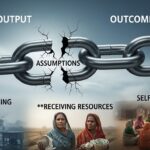



In the social sector, we often expect results before they can realistically exist.
Policies are drafted. Budgets are approved. Frameworks are polished. But when programs move from policy documents to communities, social sector timelines stretch. And that’s where impact timeline misalignment begins.
The problem isn’t intent. It’s expectation.
The Structural Gap Between Design and Reality
Most development programs are built on neat theories of change:
If we do X → Y will follow → Z will improve.
But implementation isn’t linear. It’s layered, human, and often slow.
In India, ministries that deliver visible infrastructure like roads or water pipelines can show quick results. Programs focused on health systems, education quality, or behaviour change take years to demonstrate impact. Yet they’re often evaluated within the same compressed timeframes (NITI Aayog, DMEO, 2024).
According to the Economic Survey 2024, nearly 26% of India’s general government expenditure goes to the social sector. However, implementation largely rests with states, creating multi-layered coordination that naturally extends timelines. These aren’t inefficiencies, they are structural realities.
Still, development program evaluation frameworks frequently demand outcome data long before conditions for change are mature.
That’s impact timeline misalignment in action.
Why Timelines Get Compressed
Three structural pressures drive unrealistic timelines:
- 1. Funding Cycles
- Most grants operate within 3–5 year windows. Programs are designed to fit funding cycles not real social change timelines.
- 2. Political Visibility
- Research shows welfare programs increasingly carry electoral visibility (Kapur, 2025). This creates pressure for fast, visible outputs rather than sustained transformation.
- 3. Budget Scrutiny
- When allocations shrink as seen in real-term declines for major schemes between 2019–2025, programs must “prove” success quickly to secure survival (Economic Survey, 2024).
- Compare this to infrastructure programs like Jal Jeevan Mission. A functioning tap is visible. Education quality or maternal health behaviour change? Not so easily photographed.
What Happens When We Measure Too Early
The evaluation of Educate Girls’ remedial learning program offers a powerful example. After two years, the program achieved a 1.25 standard deviation improvement in test scores far above typical interventions in India (IDinsight, 2024).
But early data didn’t show dramatic gains.
Impact required time for:
- Volunteer training
- Community trust-building
- School system alignment
- Iterative feedback and adaptation
If judged at six months, the program might have been labelled average. Instead, sustained implementation delivered exceptional results.
This illustrates a core truth: social change timelines rarely match funding or reporting cycles.
The Real Cost of Misalignment
When we expect change too soon, we create predictable failures:
Premature scaling: Programs expand before assumptions are tested, leading to null effects at scale (Bold et al., 2018).
Reporting over learning: 65% of nonprofits cite lack of skilled personnel for effective data use, turning monitoring into compliance rather than learning (ILSS, 2024).
Program churn: Initiatives are launched, evaluated quickly, discontinued, and replaced without sufficient time to mature.
The result? Constant reinvention instead of sustained impact.
What Alignment Should Look Like
Structural alignment doesn’t mean lowering accountability. It means sequencing it properly.
- Measure process quality early.
Are frontline workers trained? Are systems functioning? - Delay outcome expectations.
Behaviour changes and institutional shifts require phases. - Use staged evaluation tools.
Countries like Mexico and Chile use rapid design assessments early while reserving impact evaluations for later stages.
The theory of change literature has long emphasized sequencing preconditions before outcomes (INTRAC, 2024). The challenge isn’t knowledge, it’s discipline.
The Implementation Paradox
The more complex a problem, the slower its measurable impact.
Child malnutrition persists even in economically strong states. Education reform takes years to influence learning culture. Health behaviour change depends on trust, norms, and system capacity.
Yet urgency pressures us to demand next-year results.
The solution isn’t faster implementation. It’s smarter expectation-setting.
We must distinguish between:
- “Is the program being implemented as designed?”
- “Is the program producing population-level outcomes?”
Those are different questions and they belong to different phases.
Moving Forward with Realistic Social Sector Timelines
Structural misalignment isn’t about impatience. It’s about evaluation architecture.
If we align funding cycles, political expectations, and monitoring frameworks with realistic social change timelines, we can reduce premature judgments and prevent impact dilution.
This is where BlueskyCSR plays a critical role.
By designing adaptive monitoring systems, phase-appropriate indicators, and realistic evaluation frameworks, BlueskyCSR helps organizations bridge the gap between program design and lived implementation. Instead of chasing early optics, we enable structured, evidence-driven learning that supports sustainable impact.
Because real change takes time and with the right systems in place, it can be measured honestly and strengthened intelligently.