

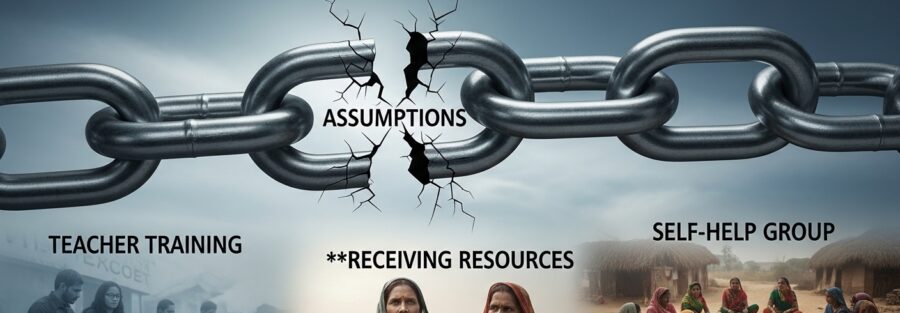
Every development program in the wider story of social change in India is built on assumptions.
“If we train teachers, classroom practice will improve.”
“If women receive microloans, they will start viable businesses.”
“If self-help groups share health information, maternal outcomes will improve.”
But here’s the uncomfortable truth: most programs don’t systematically test whether those assumptions are actually holding.
And that’s where impact breaks – in social development in India and elsewhere.
The Hidden Risk in Theory of Change
A theory of change maps how inputs lead to outputs, outcomes, and impact. But for that chain to hold, assumptions must be true.
Teachers must use new methods. Communities must trust volunteers. Health systems must be functional.
Reality often tells a different story.
In Uttar Pradesh, a health behaviour change intervention assumed self-help group member ship would improve maternal practices. Testing using structural equation modelling revealed that local socio-cultural dynamics significantly shaped outcomes (Hazra et al., 2023). Context: not just group membership determined impact.
Unidentified assumptions were influencing results.
Without deliberate theory of change testing, these invisible cracks remain hidden until final evaluations reveal disappointing outcomes in social welfare schemes in India and other programmes.
The Monitoring Gap
Most monitoring systems track:
• Activities conducted
• Beneficiaries reached
• Outputs delivered
Few track whether assumed mechanisms are functioning.
For example:
If a microfinance program assumes loans enable entrepreneurship, monitoring should examine:
• Are loans used for business or consumption?
• Are businesses profitable?
• Who controls the income?
These are assumption-level questions not output-level ones.
According to the ILSS (2024) digital transformation report, 65% of nonprofits in India lack skilled data personnel. Without analytical capacity, assumption testing becomes rare.
Programs measure what’s easy not what’s critical.
When Assumptions Break at Scale
Scaling magnifies assumption failure.
A program might succeed in a pilot with committed staff and favourable conditions. But when scaled, those enabling factors may disappear.
World Bank reviews of education interventions show several programs effective in pilots failed at scale due to contextual differences (World Bank, 2024).
The issue wasn’t the activity; it was the assumption that pilot conditions would replicate across very different contexts of social change in India.
Assumptions must be tested continuously, especially during expansion.
Operationalizing Theory of Change
Testing assumptions doesn’t require complex tools. It requires discipline
.• List major assumptions clearly.
• Define observable signals that confirm or contradict them.
• Collect evidence routinely.
• Adjust implementation accordingly.
Educate Girls’ success illustrates this approach. When community volunteers faced resistance, the program strengthened credibility-building rather than ignoring early warning signs (IDinsight, 2024).
That’s adaptive management in practice and a core capability for effective social development in India.
Creating a Feedback Culture
Testing assumptions is only useful if organizations are willing to revise their theory.
But revising plans often feels like admitting failure.
It shouldn’t.
Banerjee et al. (2017) emphasize that moving from proof-of-concept to scalable policy requires continuous learning and adaptation not rigid replication.
Programs must treat their theory of change as a living hypothesis, not a static proposal document- especially when working within critical social welfare schemes in India.
From Aspirational to Operational Theories
An aspirational theory says: “This is how change will happen.”
An operational theory says: “This is how we think change will happen. These are the assumptions involved. Here’s how we’ll test them. And here’s what we’ll do if they don’t hold.
“That shift transforms monitoring from compliance to learning.
It also protects programs from late-stage surprises.
Building Smarter Assumptions Testing Systems
Effective theory of change testing requires:
• Monitoring systems that track mechanisms, not just outputs
• Analytical capacity to interpret data
• Decision rights to adapt programs mid-stream
• Leadership culture that values evidence over optics
Without these, programs risk discovering broken assumptions only at the end.
And by then, it’s too late – for the communities depending on social welfare schemes in India and for the institutions investing in social development in India.
The Way Forward
The real question isn’t whether your theory of change looks good in a report.
It’s whether it accurately describes how change unfolds in real conditions.
That requires ongoing conversation between theory and reality.
Bluesky CSR supports organizations in operationalizing their theories of change through structured assumption testing frameworks, adaptive monitoring systems, and learning-driven evaluation processes. By embedding feedback loops into implementation, Bluesky CSR ensures
programs evolve with context rather than break under it – contributing to more meaningful social change in India.
Because the strongest programs aren’t the ones with perfect assumptions; they’re the ones that know how to test, adapt, and improve continuously